Chapter 14 of 29
How We Locked Horns with the Americans
Somewhere at the end of August 1962, we were going to the ‘ten’ for a game with some team—not with random drifters, but as proper people, by bus, all in order. A hot day, we pull up at the junction to pad No. 2 (Gagarin) and to the ‘ten.’ Good heavens, what kind of masquerade was this? KPP soldiers in helmets, with automatic rifles and gas masks, and very serious. Without explanations they turned us back to their No. 32. A command.
We return no longer so cheerful, guessing something serious had happened. And indeed, there had been a sharp deterioration in relations with the US (the Cuban Crisis), our detachment was moved to an increased readiness level, all officers in barracks duty. The married men suffered most; they were redistributed to the hostels and hotels of pad No. 32. For bachelors, the pad was the home ground. We immediately began preparing a combat missile. I should say right away that for a retaliatory strike the 8K74 missile was unsuitable, because preparing it required no less than two continuous days of work at TP and SP1. That is if the initial condition was the object in railcars. In effect, the missile could be used only for a first strike.
According to the full cycle of preparation, work starts with unloading the blocks from the railcars. The railcars looked like something between a passenger car and a mail car: green as well, with windows and curtains, either pulled shut or painted over. One railcar—one block.
A diesel locomotive shoves a railcar into the MIC hall, two side doors open at the end, and from it rolls out an apron with its own folding dolly on two small wheels, on which lies the next block. This is the beginning of the Payload Transfer and Handling crew’s work. The section chief was Tolia Alexeychuk. The crew chief was Kolya Tugolukov. In their hands were crane gear, plenty of railway saddles, and the launch fixture. Each block of the object was packed in an air-tight cover made of excellent hermetic sealing, a superb material for skinning homemade boats. The internal cavity of the cover was connected by a thick pipe to a large barrel filled with a moisture absorber, silica gel. The block was unwrapped, the cover stacked in a large basement room, where unimaginable piles of it lay. (By the way, on these dusty ‘sleeping pads’ during long test delays, with Kolya’s blessing, one could sleep.) But this privilege was only for Kolya’s buddies. I belonged to that elite club! And the silica gel—50 kilograms in each barrel—was emptied into a deliberately dug large pit near the main gates of MIC.
Next came the operations of Assembling the Item into the Package. Assembly was carried out, naturally, in the horizontal position of the item. The onboard crew made all necessary connections, and the engine men began autonomous tests of their pneumo-hydraulic systems, including pressure testing of the fuel and oxidizer tanks. They inflated them with compressed air after first rinsing all connections with Chinese shaving foam. You have to get along with these ‘oilers’ too—on a hot day, in a free minute, the ‘our people’ were allowed to tuck the hose coupling under their shirt and fan themselves with a moderate flow of air from the PGS control panel (pneumo-hydraulic system).
The test of block ‘D’ was done by engine specialist Viktor Tananaysky. This is the right lower side block of the package. A fairly cozy place near the wall of the hall. That’s where I hurried to Vitya for the much-wanted ‘bleed-through.’ Good!
On the second floor of the laboratory wing, in the big MIC control hall, after performing operations with the EBS (the equivalent of a spacecraft bus), the Horizontal Test team begins autonomous testing of its systems. The team chief was Captain Vladimir Alexeyevich Barbarich, a refined and composed engineer. In this position that was a valuable trait. I cannot remember a single test where no ‘bob’ jumped out, heaven forbid! He was also a ‘hunchback.’ Or the required operator or onboard technician simply did not appear at his station. This is exactly where the test lead, the team commander, must not lose his temper, but quickly assess the situation and calmly issue an order to correct it if he sees the section chief flustered. No one needed to be pressured. Everyone understood that success depended solely on the quality of each person’s work.
Behind the central console (NS, BS and RKS) sit Shura Shevyakov, Vova Smirnov and Slava Akimov. The range distance control, integrator, was prepared by Rivkat Gizatulin. The gyroscopes were tested by the ever-on-shift Vova Denisov. APR, the missile arming automation, was prepared by Sergei Bessmoly. And we, with Yuri Gubarev, led our native SOBIS console. Each operator wore a laryngophone around the neck.
Besides the main work of autonomous verification of their own blocks, the SOBIS onboard crew was assigned checking the UN and SPN sensors (Fuel Level Indicator and Overfill Indicator). These are two capacitive sensors with connectors at the very top of each side block and the central Block A. They are not our sensors at all, but the launchers’. They are used when filling the object with oxygen.
To carry out this check, two of the youngest lieutenant operators climbed up via a huge multi-story extension ladder from the end of the object, bypassing the copper-gloss engine nozzles on the central block and, clattering over the already opened cable box (treading right over it), they blew to the very nose of the rocket. They had a tester and a megohmmeter. Checked, turned the plug, and after smearing glue ‘88’ they sealed it with a paper strip with our signature. The same procedure was repeated on the remaining four side blocks.
On the first floor, the missile radio-control onboard electronics are tested by the radio operators’ section headed by Vitaly Morozov and the chief engineer for telemetry and radio systems of the complex, Albert Kovriga.
At last it sounded on the loudspeaker: ‘everyone move away from the engines, an operation to check the steering rocket engines is being conducted.’ It is dangerous to health—all twelve steering engine nozzles (thrust of 16 tons each) unexpectedly begin turning in different directions. And then, after reporting the completion of inspection of the last device of the missile with the standard ending ‘no visual remarks,’ they announce: ‘Onboard crew, assemble the sequence for integrated tests of the item.’ The detachment of lieutenant Gasyuk starts fussing with the cable-connectors, and for us panel operators a short break. Some go to the smoking room, but practically everyone goes to the drinking station to sip warm water after the hot console room.
A drinking station is an upturned water pipe set at a right angle, usually ending with a turned brass fitting with a tap.
The control room by this supposedly sensible design is on the top floor under a reinforced-concrete ceiling slab, covered with tar on top. Heat just poured in from the ceiling all day long and, by inertia, even at night; as far as I remember, this tar constantly dripped down the outer wall from the roof and onto the ground. (It was lucky that the entrance to the structure was sheltered by a small overhang.) And this hall with its hot ceiling was lined around the perimeter with consoles slightly larger than a piano, but packed with a lot of burning signal flags. All this illumination also gave off heat. No fans and no air conditioners. And the crowd would sometimes be packed full.
When preparing a launch of a new2 missile, or one such item that TASS3 would later report on, on TP (the technical position) and then on SP (the launch position) nearly all the Generals and Chief Designers gathered with their deputies. It was good they did not bring all the developers of their systems with their scientific-engineering platoons and battalions, with fitters, assemblers and installers. (Each serious enterprise kept ‘deciats’ and large expeditionary staffs on the pads and in hotels.) All these important ‘suits’ crowded in behind us in the control room, some for laurate status, some simply for a bonus. That is understandable and fair. But why in our control room or on start, our native local priests of all kinds? For orders. (What a serious look they wear now in civilian clothes! True heroes of cosmic achievements!)
It rang: ‘Onboard crew, take your workplaces, readiness for integrated tests in 15 minutes.’ We sit down before the consoles. Closing in, they take the best seats behind our backs: the controllers from the 1st command of the test range and the ‘suits.’ And then it moved—what was going to happen: ‘supply power to the onboard system, check initial values and report readiness.’ From this moment telemetry operators are connected right up to us. Not far from building 14, behind the rocket storage in a one-story barrack, stations ‘Tral 1S’ are located. Later they will move into the new large MICCO building. Now all ground and onboard parameters will be recorded on film by the ‘Tral’ photorecorders.
The voices subsided. Everyone waited for the commands ‘Protyazhka’ and ‘Launch.’ We logged in4, simulated pre-launch, launch and flight manipulations of ground and onboard systems, all to 120 seconds for the side-block sections, and to 340 seconds for the warhead section. We also tracked our SOBIS ‘force’—‘dross.’ We checked the initial points and together went to drink warm water and smoke. But first, a collection hour was announced in the viewing hall. To watch parameters.
Processing Tral film is fast, because for development they use alcohol—rectified spirit—instead of water. But if processing drags on, everyone is convinced the telemetry guys diluted the booze, darn it. In a couple of hours, or even sooner, they invite everyone to the viewing hall. The hall, nearly 50 meters long, was fully filled along its whole length with special slanted tables with internal daylight lighting. Under transparent covers the film strips were laid out. On each strip up to ten parameters were written. The telemetries had already labeled all parameters and even had time to pre-view them. I note here the precise and professional work of Boris Khanin. People spread through the hall, all of them intent and leaning down. You could hear continuous murmuring from all sides. They were digesting it.
But in real launch-site life, tests as beautiful as I described do not occur.
In the normal flow of testing, even during autonomous checks, something goes wrong compared to what was planned. And immediately the schedule of horizontal work flies off, which directly complicates the whole network schedule.
Analysis, removing a suspicious block from the onboard item, some rewiring, reinstating initial data, repeated work with EBS and other nonsense. Everyone else not involved in fixing a ‘bob’ can relax within hearing distance of the loudspeaker. If the character of the failure makes a long delay obvious, then somewhere one has to ‘fall down.’ By the clock it is already deep evening or all of this is happening before dawn. Or this swirl may already be dragging on for a second day. There is no cafeteria or other conveniences in MIC. Even the toilet traditionally is outside the building, in the steppe.
The time limits for moving the item to launch were tightening; we worked ‘to the limit.’ Someone settled on the cover of his own console, someone on chairs, and the white people lay down in the basement by Kolya Tugolukov, on the hermetic wraps, in twilight and coolness. Beautiful! The covers were only a bit dusty.
A loud siren wakes us. Everyone already had red eyes, a bit darker in mood. Fewer conversations and no fresh anecdote from our own ‘industrialists.’ Everything over again.
Not even half the technology cycle had passed when something new flew in. It is really bad when one has to wait for the arrival of an aircraft with some urgently reworked block from the manufacturing plant, the producer a thousand kilometers away.
We do not fear SOBIS ‘hunchbacks’ because we are equipped with a fivefold spare-parts set, checked by us every six months. Such redundancy is not due to potential hardware unreliability at all, but solely to the overinsurance of the Generals. General ‘Zenit’ lays in his own spares kit, General ‘Molniya’ his own, for ‘Metiors’ his own, purely for R7 his own, and so on. Though SOBIS did not care whether to launch a combat missile with a thermonuclear head or to put a satellite into orbit. That was just how it was. A wealthy country! And for the highest reliability of the system, thanks to the Ryazan developers and manufacturers.
But what a glow was on everyone’s faces when everything was finally back to normal.
So here it is. We prepared two missiles; to one of them nose cones were attached, and that missile was installed in the launch structure.
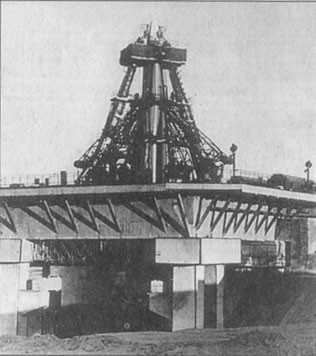
The 31st launch structure 8K74 was installed.
At some point things became serious for real. It was calmly accepted that if our item flew away, we could be considered dead men. So to speak, we would have died for the radiant tomorrow of the Cuban proletariat. They would not have had time to install the second item in the launch structure. I cannot remember the activity of political workers. Either they had been ordered not to hover at our feet, or they had simply been scared. Even more ‘joyfully’ the boys from the Mikoyan expedition in Cuba felt. Later some details of this dangerous standoff were learned from some of the ‘Cubans.’ (See Appendix)