Chapter 23 of 29
Disaster in Military Unit 14056
On 18 March 1980, at Site 43 of Military Unit 14056, an 8A92 launch vehicle exploded and caught fire as fueling was being completed. It was the second day of preparations for the launch of spacecraft 11F619, the Tsikada-D signals-intelligence satellite. The vehicle used liquid oxygen as its oxidizer and kerosene as fuel.
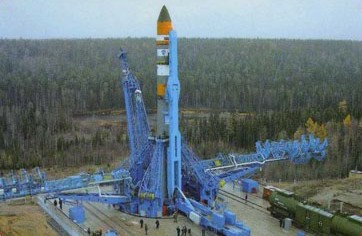
A modern view of the launch complex at the moment of RN installation. The first start day.
According to the technological schedule, during this operation at the launch structure and around it, a large number of testers from the combat team and controllers of the second control were involved. As a result, 46 people died immediately, another 6 died from burns in the following days. I saw photographs with “okoroks” hanging from the trusses… The catastrophe happened in that same part where I started my service after graduating from Mozhaysk.
Of course, during testing of rocket equipment on the northern as well as the southern test site, people died from time to time, but not in such quantities. Not counting the Nedelin catastrophe of 1960. From my memory, the largest previous catastrophe at the northern test site took the lives of 9 testers.
Earlier, when describing my “feats” at a similar start of the same carrier at the southern range, I noted the exceptional reliability and safety of this Samara-made product. After oxygen fueling, anyone in the launch crew could calmly scrape snow off the side walls in Turyatam heat for their own cooling. And then something like this!!
In the proud traditions of “organizing, guiding and leading to heroism,” the CPSU Central Committee decided to bury all the dead at the range so as not to bring the dirt out of the hut. While the relatives of the deceased arrived, the bodies of the victims were stacked in some unheated shed, since the hospital morgue was not designed for so many clients. The cold was intense, everything froze, and when the time came to fill the coffins, soldiers had to be made to drink so this mass could be cut apart with a chainsaw.
And then the funeral day came. The coffins were placed in the main hall (cinema hall) of the officers’ house, with a sloping floor. Two shifts of honor guard were formed, one officer at each coffin. It was agreed to alternate every 15 minutes. I was placed in the first shift.
We enter the hall. Behind the curtain, a garrison orchestra keeps playing something nonstop. Along the stage are tables with some medical paraphernalia and a group of medics in white stands ready. The medics had already had to work hard, calming and holding back the crowd of relatives who had arrived. And the whole unrecognizable hall was uniformly filled with red-nailed coffins, placed on stands, with a large photograph of the deceased and six chairs at each. We were lined up at the head of each, beside the photographs. We stand and wait. We wait for a long time. Half an hour, at least. (I am writing this now and do not know how to convey the whole horror that followed, because I remember everything as if it were yesterday).
Both door leaves through which we had previously entered for the movie show open, and instead of entering, a screaming mob bursts into the hall—men and women, all with wide-open shouting mouths, all running around the hall without stopping, searching for their loved ones. Through it all, amid the rising wild roar, I can hear that they began dragging out the coffins and trying to open them. A crash and some scuffle. This deafening roar made the hair under my cap stand on end. Near my burned coffin, frightened Tajik relatives gathered. It smelled like some sort of medical filth, and from all sides there were cries of “doctor!” The second shift scattered and did not come to replace us. And they had seen nothing—only heard. I did not lose my mind there, but my nerves were certainly knocked badly.
And with my psyche in those minutes, something happened anyway, something protective, because I do not remember at all how this farewell of relatives to the deceased ended…
Then there were funerals with a procession through the whole city. I carried the second wreath.
The commission investigating the causes of the carrier rocket explosion did not come up with anything smarter than accusing one of the control officers, Major Daminev, of “allowing a relaxation of technological discipline leading to …”. I had known Marat from Mozhaysk; he graduated from the academy in the mechanical faculty in the same year as me and also got an assignment to Plesetsk. With a poor evaluation and in the worst moral condition, he was immediately discharged from the Air Force ranks.
Many years later, in the era of glasnost, central television in a special segment of the TV series “How It Was” told about the true causes of the rocket explosion. It turned out that the manufacturer of the hydrogen peroxide refueling filters, in Sumy, had secretly changed the process, and the factory had itself soldered these filters. This “rationalization” caused inadmissible overheating at the joint where the solder interacted with the peroxide. The most outrageous thing is that the factory people kept silent for so many years after the catastrophe.