Chapter 22 of 29
Service
As the army saying goes, “so that service does not taste like honey,” guard duty came around from time to time and naturally took us away from our main work.
Command officers stand on practically the same watches as officers of subordinate units. Most often this meant patrols through the city or duty commander at Plesetsk station. Starting in year 80, I began to serve as an assistant to the range duty officer at the command post. That was service! The shift at the command post is changed at 10 o’clock in the morning. Sometimes there were such tense and nervous watches that when, after changing shifts, I was already at home at breakfast, the spoon shook in my hand.
The test range is a huge enterprise with many units, separate detachments, thousands of soldiers and officers, and most importantly, a multitude of technical tasks solved day and night during testing of equipment. All this enterprise, all these objects—missiles, satellites, launch vehicles, silos, the ground segment, and all the assembly and launch-readiness technology—is controlled by the Main Staff. And all of it has to be known, one must be able to grasp the essence of a matter quickly, instantly orient oneself in complicated non-standard situations, and answer clearly or report upward. All while, in practice, knowing almost no details of the matter. And this does not include accidents involving the deaths of servicemen.1
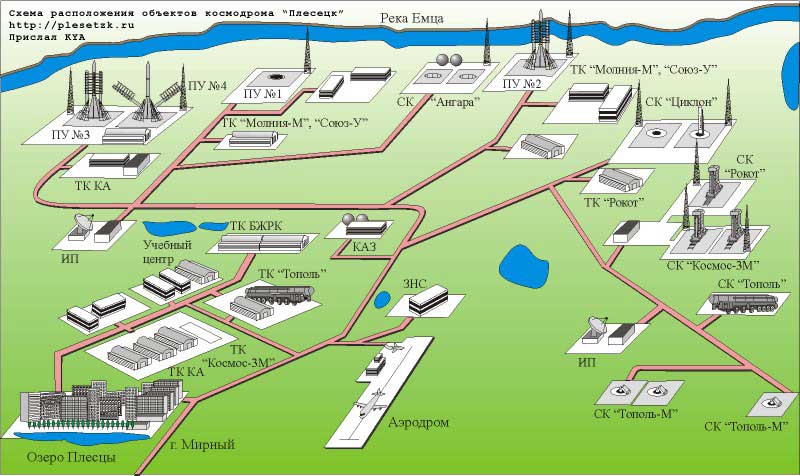
This is the present infrastructure of the range. In our years, much more tasks were solved.
We receive all information from the unit duty officers. And they try, in case of an emergency, to polish things up, or keep quiet. Or they simply do not have information about the progress of important tests and the causes of failures or delays. At the TsKP they wanted to know everything down to the last connector. Immediately. Time limits were set for all kinds of reports. This is not a casual patrol through the city with a stream of anecdotes in the guardhouse.
Duty at the CP was very tense on launch days, especially if the launch was an emergency one. In addition to mandatory reports on the progress of work in each testing directorate, it was necessary to provide a running report on launch preparation and on the flight of the product itself. There were, of course, calm watches, relatively. And in one of those watches, carefully studying the list of the higher Missile Troops command behind the glass, I noticed without much surprise the complete dominance of generals and political officers with Ukrainian surname endings. Just as the ChVS (member of the military council) came from Ukraine. Even at a young officer age I had noticed this wonderful Ukrainian pull toward such a “specialization.” But I still did not expect to see such a vivid picture. A pity there was no one with whom I could share what I saw and discuss it. The time had not come yet.
Then came endless Marxist-Leninist study, seminars. And the most miserable part of this skill-less wasting of time was keeping three big notebooks. In one you write down the lectures, in another you enter work with primary sources, i.e., demonstrate your understanding after you have painstakingly clung to the undying works of Marx, Engels, and Lenin. And in the third, as required, you entered your understanding and enthusiasm for the latest decisions and decrees of the Central Committee of the dearly beloved party. The range print shop made these notebooks for management officers in hard red bindings with gold-embossed titles. A real showpiece, not notebooks. In seminars, in our holy notebook-books, the political workers shoved their noses in and voiced conclusions.
All this disgust followed me from my first day of service in the Soviet Army. But one fine day, it struck me, and I devised my own secret antidote. It was not for nothing they called me a “generator of ideas.” In the lectures all officers listened dimly, half-asleep, and only became animated when the lecturer suggested something especially noteworthy to enter in the first notebook. Then, when preparing for the next seminar, one would have to write something in the second notebook so that the old men could see you were aware of the “founders’” thoughts on this issue.
It was remarkable that for any modern economic, military, or party-building question the “founders” always had an “exact and profound answer.” That was especially touching. So. I did not sleep during the whole first hour of the lecture and worked intensely. Into each of the three notebooks, continuously and regardless of the lecturer’s pace, I copied fragments of everything he carried from the rostrum. I placed periods, marked paragraphs, left margins for headings. Of course, reading this gibberish is impossible. But then I did not spend a minute of my precious personal time on this nonsense, and during inspections I had something to show.
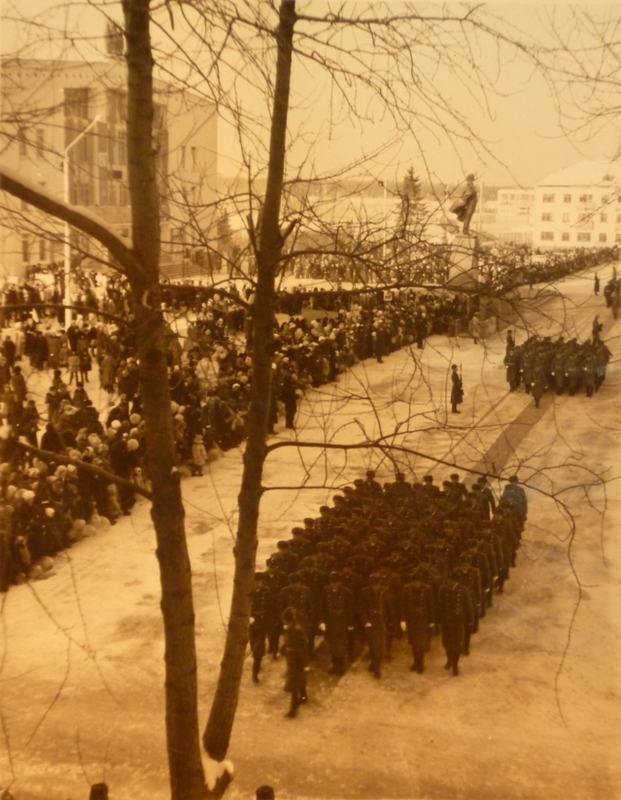
On all “revolutionary dates” we march past the Officers’ House with our eyes set on Idola. (The only time I managed to avoid the hated drill was on November 7, 1985. I photograph from the balcony of the Milenins’ apartment.)
It is a pity I am not a writer, but I have the urge, it gnaws at me, to tell my descendants my view of the military political worker institution. About this mob of shrewd or dull officers produced in unbelievable numbers by military universities. And they are given all-Union standard diplomas, just like graduates of the pedagogical institute. And their salary is not a teacher’s salary at all. Still, that is the youth. Maybe someone went this way by folly or out of hopelessness. But when a fully mature officer with a technical education turns into a political worker, I feel nothing other than quiet contempt for such a former engineer.
And here is this crowd, armed with fake and stillborn Marxist-Leninist ideas, set above the whole mass of servicemen. Everything is under their relentless control. Even the range commander gets his political report written by the head of his own political department. And where there is success, there is “under the leadership of the CPSU… Carrying out the decisions of the Congress…” And where there is an accident, friendly fire, unsuccessful launch, then there is inevitably mention of “political-educational work launched in the unit… low demands… personal irresponsibility…” The duty refrain about “polimarsos” and “morbokach.” Those are their professional abbreviations: “politico-moral state” and “moral-combat qualities.” And this crowd is always found spotless. And this department is the personnel section. After setting all records for sitting on major ranks, I go down to the second floor to the “divines,” to personnel. All of them unsmiling, worried, businesslike, and even a bit mysterious.
From their smart faces you can see how they endlessly think—think, how to raise political work in the masses to even greater heights, so to speak, to ignite us green and lead us to new achievements. They do this to each other like parrots spreading their tails on a rod. Maybe the chief priest will notice. I asked the personnel officer, Major V. Bogomazov, a still very young political worker, recently having fled from engineering work to the harder, political track, saying, in essence, how much longer they will keep bugging me. But Vitya had apparently already absorbed Mehlis’s wise advice: “A party card makes a fighter twice as strong!” and replied that the political organs were surprised how they had even assigned me a major rank…” He clearly believed that a non-party officer is twice as stupid as a party one. In the SRF, political workers are not even put on watch shifts. They are afraid of getting hit, jerks. This is not talking nonsense in jargon from morning till evening for all 25 years until a deserved pension. How can one not remember Faina Ranevskaya’s parable about the Lord God’s good intention to endow Soviet people with three qualities at once: intellect, honesty and party-mindedness. But Satan persuaded God to make do with two, so it turned out like this: If a person is intelligent and honest, then non-party. If intelligent and party, then dishonest. If honest and party, then a fool.
Footnotes
-
For example, on 25 June 1973, during preparation for draining components of the launcher 11K65M after an aborted launch, an explosion occurred and in the fire that followed the entire fueling crew burned—9 people. On 26 January 1983, the same LV 11K65M with almost full tanks of unburned propellant (propellant components were heptyl and nitric acid) fell into the ice of the Northern Dvina in the Brin-Navolok area (Kholmogory District, Arkhangelsk Region). A hole of 100 m in diameter formed. The rocket was not found. Arkhangelsk and the settlements below the crash site along the river lived on delivered water for a month.
↩