Chapter 29 of 29
Appendix: How Khrushchev Stood Up for ‘Our Fidel’
Appendix 1. How Khrushch Stood Up for “Our Fidel”
The account of retired Major Anatoly Anikeev
It was planned to send to Cuba a group of military personnel centered around five nuclear missile units, three of them equipped with R-12 missiles1 (24 missiles) and two with R-14 missiles2 (16 missiles). 40 ballistic missiles in all.
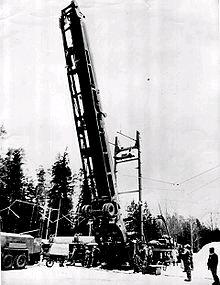
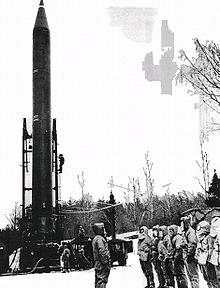
In addition to the missiles, the group included four motorized units, two tank battalions, a squadron of MiG-21 fighters, forty-two IL-28 light bombers, two cruise-missile units, several batteries of antiaircraft guns, and 12 SA-2 missile units (with 144 launchers). Each motorized unit consisted of 2500 personnel, and the two tank battalions were equipped with the latest Soviet T-55 tanks. Such an organization was novel in the Soviet Army, where ballistic missiles had never before been included in an army group.
In the program outlined by Malinovsky on 10 June, nuclear assets were not limited to medium- and intermediate-range missiles. Two cruise-missile units (“front-line cruise missiles”—FKR) also had nuclear warheads. The Ministry of Defense decided to send 80 such missiles to protect the Cuban coast and the area adjoining the American military base at Guantánamo. The missiles had a range of about 160 kilometers and a nuclear-warhead yield equivalent to 5.6 to 12 kilotons.
The details of Malinovsky’s plan showed that Soviet military planners regarded the Cuban operation as an opportunity to project their power into the Western Hemisphere in the course of a mission to save Fidel Castro. In all, 50874 military personnel were sent to Cuba. The Soviet Navy intended to use Cuba as a base for both Soviet and Cuban defense. As part of deploying the Soviet military group in Cuba, the Navy decided to build a submarine base on the island, including a maintenance facility for new Soviet submarines equipped with ballistic missiles. To defend the island’s coast, the Soviet Navy intended to send a small flotilla: two cruisers, four destroyers (two of them with missile launchers aboard), and 12 Komar-class boats, each armed with two R-15 missiles carrying conventional warheads and having a range of 16 kilometers. To patrol the East Coast of the United States, the Navy planned to send a detachment of 12 submarines, including seven equipped with missiles carrying nuclear warheads. Each submarine carried three ballistic missiles (R-13) with warheads yielding 1 megaton. Of all the weapons systems intended for Cuba, Soviet ballistic-missile submarines were far more suited to asserting Soviet strategic power than to preventing the impending U.S. military action against Castro. In terms of nuclear yield, the R-13 missiles with which they were equipped were equivalent to medium- and intermediate-range missiles.
“June–July 1962. The first time they assembled us was in Akhtyrka, Sumy Oblast. The missile division was stationed in Romny. They gathered only Slavs. The officers were mostly married men. (By this time, Tolya had already served for about a year in Khmelnytskyi).
The interview-interrogation was conducted by visiting lieutenant colonels. 12 officers were selected from my unit. After screening, 7 remained.
The Akhtyrka missile regiment was armed with 8K63 missiles. Each assembly brigade (the “bigheads”) serviced its own regiment. The brigade had several crews, corresponding to the number of missile launch sites it serviced.
In July, Army General V. F. Tolubko3 arrived at the unit for an inspection.
Someone spread rumors that we would be sent north or to India.4 (In those years, our leaders were assiduously courting the Indian leadership).
Finally, in August, 10 officers and a few soldiers arrived by train in Sevastopol. The soldiers were mostly layabouts, but in the character references sent from their units they were listed as “excellent performers.” They were quartered in a military settlement with an unambiguous warning about wartime regulations (leaving the settlement meant trial). They did nothing but study the regulations and engage in sports. Later, 200 women—doctors for a military hospital—were brought to this settlement.5 Everyone was changed into civilian clothes. Lieutenant Tolya Anikeev was given a huge suit, completely out of proportion to him. Officers were to wear ties, soldiers with their collars unbuttoned. The suits were of various cuts and colors. To reinforce the chain of command, officers were issued hats and soldiers caps. Anti-mosquito nets and railway cars full of felt boots were delivered to the warehouses. Naturally, this was to reinforce and strengthen the deception. Before loading, a colonel spoke and promised that a year of service would count as three, and generally talked about mountains of gold. Pure, ordinary political-officer lies.
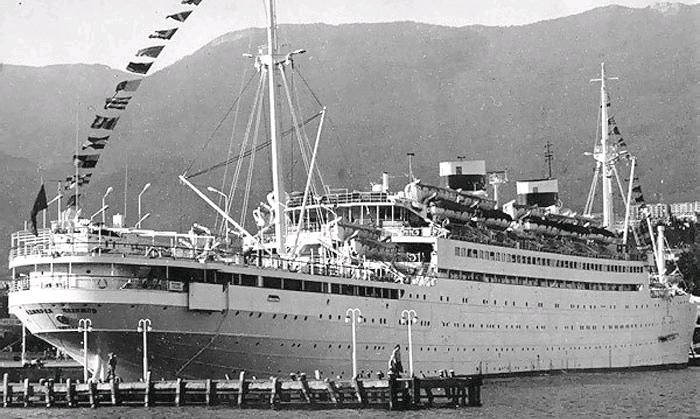
They loaded us at night, without documents, onto the motor ship “Admiral Nakhimov”.6
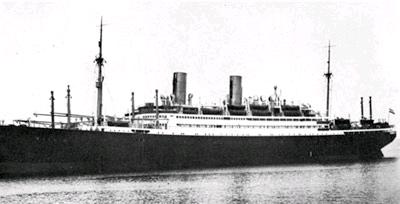
The liner “Berlin”
Senior officers and the hospital were placed on the upper deck. Junior officers were placed below, in 1st-class cabins. A copy of a railway compartment for two people. 5 lieutenants were crammed into each one. In Tolya’s cabin, Lev Tolstoy slept on the floor, a very fat and large lieutenant. The portholes were battened shut! It was terribly stuffy.
At the very bottom were the soldiers—unbearable heat and stench.7
Early in the morning we passed Istanbul. While sailing through the Mediterranean, no one was allowed onto the upper deck. Everyone was told that they were sailing to India. The expedition’s actual final destination was announced two days before Havana. Walks on the upper deck were permitted after we entered the open ocean.
We were at sea for more than two weeks. The vessel’s maximum speed was 14 knots. Every two days, the clocks were set back by an hour.
As we approached Havana, everyone was herded into their cabins and warned that when the pilot came aboard, no one was to stick their nose out.
In Havana itself, they allowed us onto the deck. The port and the city looked beautiful, and the roads perfect.
They drove us through Havana and then another 120 kilometers into a palm forest near the settlement of Santa Cruz. This small advance party of ten officers and twenty soldiers was to prepare a place for their brigade to live and get by. We set up tents, but slept outdoors the first night. No mosquitoes, at least. Many beautiful fireflies appeared. We woke in the morning to find all our clothes riddled with holes by some mighty moth, possibly those wonderful fireflies.
They issued us dry rations for three days: rusks, sugar, tinned meat, tea. Water came from a beautiful stream 0.5 km away. The stream had fish resembling crucian carp, but catching them was forbidden—they cleaned the stream. For about two weeks we were effectively idle. Neither soldiers nor equipment. We found a clearing with lemon trees bearing small fruit.
Our brigade arrived. The neighbors—the missile troops—began installing their equipment.8 However, the naval blockade that had begun9, the island’s 500-mile “quarantine,” made their lives somewhat more difficult. One of the missile division’s regiments failed to receive its refueling vehicle on a blocked vessel at sea. This complicated the execution of future tasks somewhat. In all, about 50 thousand servicemen were delivered to Cuba, including the missile division at full strength.
The brigade, working in unison, began preparing foundation trenches with shovels. They traveled 100 km for sand for concrete work. We were very surprised that the Cubans worked only until five in the evening. In a complete absence of patriotism and enthusiasm. If they had not managed to load up by five, they returned to the unit empty-handed.
American aircraft—reconnaissance planes—began flying over the forest. At first high, afraid of the air defenses, and then lower and lower. Right over the palms.10
Martial law was declared. We were forced to dig trenches and build dugouts from palm trunks. We received weapons. Pistols for the officers, assault rifles for the soldiers. Two crates of grenades for each tent. Two tanks were sent. When going on guard duty, an officer put on a holster belt over his civilian shirt.
We conducted a trial run to Havana by car, to get familiar with the road and learn where and how to drive at the required hour. (The warheads—hydrogen bombs—had been stockpiled beneath the city.) On the way back, one of the cars got lost. The senior person in the car was Lieutenant Kolya Malamuzh. We searched all night. Also on this return trip, three officers stopped near some bar outside Havana. The owners were extremely hospitable and plied them with full glasses of rum. “Compañeros, compañeros!” They came back in such a state that one of them was unconscious. The commanders gave them a dressing-down, and throughout Cuba banned the sale of alcohol to Russians. A liter bottle of spirits cost 1.20 pesos, which was about 1 ruble in our money. Upon arriving on the island, everyone was issued 25 pesos. These “pesos,” equivalent to 22 rubles 50 kopecks, were deducted by the motherland’s government upon our arrival in the Union. A kind country that sent its sons to the slaughter. (The Kremlin bastards never did learn to respect their citizens.)
There was an acute shortage of soap and toothpaste in the unit.
10 days after martial law was declared, representatives of the UN arrived, and they were shown all the military equipment, which they photographed meticulously. It was already November. Immediately after the UN visit, a three-week dismantling of the equipment and redeployment to the port of Mariel for loading began. Loading onto the freighter began on November 7 and ended two days later. I have forgotten the name of the ship. The return journey took exactly two weeks, since the freighter was faster than the “Nakhimov.” We traveled even more “comfortably.” Bunks in four tiers!
The brigade traveled on a freighter with the “regimental men,” that is, with a missile regiment. 2 missiles lay on the very top deck. At the Yankees’ demand, the missiles were uncovered and photographed from airplanes and helicopters. Everyone was warned not to shake their fists or make other indecent gestures, but to behave with dignity. We traveled surrounded by ships and aircraft carriers.
Lightly equipped, in jackets, we arrived in Königsberg. I remember that upon arriving at the port, we could not get enough of simple bread. During the last week on the freighter, they had fed us nothing but foul rusks. The equipment was unloaded directly onto railway flatcars. The officers went into compartment cars, 6 officers per compartment. Tolya took the third bunk, while the soldiers were stuffed into unheated freight cars and hauled like cattle to Akhtyrka. A new unit was already quartered there, and no one was expecting us. The officers were housed in the soldiers’ barracks together with the soldiers of this new unit, while the “Cuban” soldiers who had not yet changed clothes were placed in garages between the vehicles. The soldiers quickly sold their civilian clothes in a neighboring village for vodka. Quite often in the evenings, the unit’s soldiers fought brutally with drunken “Cubans”.
We read in old newspapers about the recent confrontation with the Yanks, and “our hair stood on end.” It dawned on everyone what a deadly assignment we had been on. There in Cuba, they had skillfully concealed from us the severity and scale of the conflict and where matters were heading.
For two weeks the officers were not paid and had to openly go hungry. They sent one of the married men home, and after eating at home he brought bread, potatoes, and other things to the unit. But once we got paid, we did not leave the local restaurant for several days.”
Footnotes
-
Type: intermediate-range ballistic missile Status: retired from service in June 1989 Developer: OKB-586 Chief designer: Yangel, M. K. Years of development: R-12: From 13 August 1955, R-12U: From 30 May 1960 Beginning of testing: R-12: 22 June 1957 - 27 December 1958, R-12U: December 1961 - December 1962 Acceptance into service: R-12: 4 March 1959, R-12U: 9 January 1964 Units produced: 2300 (manufacturer: Krasnoyarsk Machine-Building Plant) Years in service: 15 May 1960 - June 1989 Main operators: Strategic Rocket Forces. R-12U modifications Main technical specifications:
- Maximum range: 2080 km
- Warhead mass / throw weight: 1600 kg
- Number and yield of warheads: 1x2.3 Mt
- Accuracy (maximum deviation): 5 km
- Oxidizer: AK-27I
- Fuel: TM-185 (a hydrocarbon mixture close to turpentine).
- Working fluid: product 030 (80% hydrogen peroxide).
- Launch fuel — TG-02.
- Launch mass of the missile: 41920 kg.
- Body diameter: 1652 mm, across the stabilizers 2652 mm.
- Length (with warhead): 22768 mm.
- Throw weight: 1400—1600 kg.
- Type and yield of warhead: thermonuclear, 1x1 Mt or 1x2.3 Mt.
- Firing range: 2080 km
- Accuracy (maximum deviation): 5 km
-
R-14 missile, index 8K65, 8K65U. NATO classification SS-5 “Skean.” Purpose: intermediate-range ballistic missile. Developer: M. K. Yangel, OKB-586. Manufacturer: Krasnoyarsk Machine-Building Plant.
Main specifications
Number of stages: 1. Length (with warhead): 24.4 m. Length (without warhead): 21.62 m. Diameter: 2.4 m. Launch mass: 86.3 t. Throw weight: 1300—1500 kg (light warhead) or 2155 kg (heavy warhead). Fuel type: liquid. Maximum range: 3200-3700 km, 4500 km (with a light warhead). Warhead type: monoblock thermonuclear, separable. Number of warheads: 1. Yield: 1 or 2,0-2,3 Mt. Guidance system: autonomous, inertial.
↩ -
Vladímir Fyodórovich Tolúbko (12 November (25 November) 1914 — 17 June 1989) — Soviet military commander, Chief Marshal of Artillery (1983), Deputy Minister of Defense of the USSR, Commander-in-Chief of the Strategic Rocket Forces (from 1972 to 1985)[1], Hero of Socialist Labor (1976).
↩ -
In the legend prepared for the operation, the final relocation point was Chukotka.
↩ -
A total of three hospitals were deployed, each with 200 beds
↩ -
The passenger liner “Admiral Nakhimov” was built in Bremen (Germany) in 1925 and initially bore the name “Berlin.” In 1938, it was transferred to the German naval forces and converted into a hospital ship. On 31 January 1945, it struck two mines and then another on 1 February, after which it sank off Swinemünde.
In 1946-1947, Soviet divers raised her, and she became the property of the USSR as reparations from Germany. In 1951-1957, she was restored and renamed “Admiral Nakhimov.” In 1957, she was transferred from the Baltic to the Black Sea, becoming the largest Black Sea liner.
Displacement: 9000 tonnes
Length: 174.3 m
Width: 21.1 m
Machinery power: 12000 hp
Speed: 16 knots
On 31 August 1986, carrying 888 passengers and 346 crew members, while heading out of Tsemess Bay toward Sochi, the “Admiral Nakhimov” collided with the bulk carrier “Pyotr Vasyov” and sank in 6 minutes (at a depth of 47 meters), taking 423 lives.
↩ -
Igor Kurennoi, assistant head of the political department in 1962 in the 43rd Strategic Missile Division: “Permission to go out on deck was granted only at night, and even then in small groups of personnel. Everyone sat in the tween decks, in the multi-tiered holds. That was the situation. Excuse the frankness, but naturally there were no toilets there either; they lowered a bucket down there. This bucket was used for its intended purpose, as they say.”
↩ -
The flight time to Washington was five minutes. To make New York uninhabitable, a single missile would have been enough.
↩ -
On 22 October, the United States imposed a naval blockade of the island. Opposing the five American carrier groups blockading the island were just four Soviet diesel submarines. They had come to the Caribbean Sea from Severomorsk.
As soon as the submarines entered the Bermuda Triangle area, they were placed on four-hour readiness to use their weapons. In addition to the regular torpedoes, each submarine was loaded with one torpedo carrying a nuclear warhead. This weapon could be used only with permission from Moscow.
Our diesel submarines proved completely unsuited to operating in the tropics. Temperatures in the compartments reached 50 degrees. Fresh water had to be conserved. The submariners were barely able to keep from losing consciousness.
Valentin Blazhenin, deputy commander in 1962 of the “Buki-4” submarine: “In the morning they gave us a glass of tea, and in the evening a glass of kompot; during the day, somehow or other, a first course, soup that one did not want to eat in that situation. Yes, that was all there was. We had prickly heat. That is when the skin in the creases, under the arms, and in the groin blisters and bursts.”
At night, the submarines surfaced to start their diesel engines and recharge their batteries.
Alexei Dubivko, commander in 1962 of the “Buki-36” submarine: “There is a command: ‘Anti-submarine vessel. Emergency dive!’ At that moment the sonar operator reports: ‘Comrade Commander, I hear the sound of propellers; the sound has split in two, one sound is moving toward the stern.’ I think, if the sound has split in two and it is close, with one moving toward the stern—that is a torpedo.”
Having evaded the torpedo, our submarine nearly collided with an American ship.
Alexei Dubivko, commander in 1962 of the “Buki-36” submarine: “This ship passes directly over me, heading straight for a ramming attack. Well, I think, now there will be bombs. My assistant is standing behind me. I think, now the bombs—and it’s the end!”
But they did not bomb the submarine, and it managed to disappear. On 27 October, a Soviet air-defense missile in Cuba shot down the American U-2 reconnaissance aircraft. The pilot was killed. The situation became extremely tense. An American landing force was expected on the island.
Nikolai Goncharov, deputy commander of an air-defense unit in 1962: “All the soldiers were driven into the trenches; helmets, light machine guns, and grenades—everything was handed out.”
Igor Kurennoi, assistant head of the political department in 1962 in the 43rd Strategic Missile Division: “We understood perfectly well that we were already living on borrowed time and would have to leave this world together with the Cubans. It is not that we were fearless there… Naturally, everyone was anxious; we were all young, and all of us wanted to live.”
The Soviet nuclear missile divisions in Cuba received their flight orders.
Igor Kurennoi, assistant head of the political department in 1962 in the 43rd Strategic Missile Division: “If we had seen that an air bombardment was underway, we would, of course, have launched a nuclear strike. That was our instruction; those were our plans.”
According to American analysts, the United States could have lost 70 million people in a nuclear conflict at that time. President John Kennedy chose to negotiate. Nikita Khrushchev agreed to remove the nuclear weapons from Cuba.
↩ -
U-2 pilot Major Rudolf Anderson was killed, becoming the sole victim of the confrontation. At approximately the same time, another U-2 was nearly intercepted over Siberia because General Curtis LeMay, Chief of Staff of the US Air Force, ignored the US president’s order to halt all flights over Soviet territory. A few hours later, two US Navy RF-8A “Crusader” photo-reconnaissance aircraft were fired upon by anti-aircraft guns while flying over Cuba at low altitude. One of them was damaged, but the pair returned safely to base. ↩