Chapter 19 of 29
The Avdonkins and Vova Kochnev
For me, the most significant event in Petersburg was getting to know and becoming friends with the Avdonkin family: Vera Ivanovna, Sergei Ivanovich, and their children, Milya and Andrey.
The classic Petersburg intelligentsia. Sergei Ivanovich, a lecturer at our Academy, a colonel, a music lover of the highest calibre, and a wonderful photographer. Sergei Ivanovich had a large home phonotheca and deeply understood the most modern recording and playback equipment. I am sure that whatever he took on would be done at the highest level. And his children are also advancing through life very well. I met Sergei Ivanovich quite by chance, in my first year, near a large display with photographs of Petersburg, including some taken by Colonel Avdonkin himself. He seemed to think I was explaining something about the shooting technique of the presented images to my fellow students quite professionally. He approached us and a conversation started, and as a result I was invited to his home. Then everything naturally moved on to music and sound recording. And that was very much my element. And the most surprising thing was that the musical tastes of the colonel, a Candidate of Technical Sciences and a stalwart, matched mine exactly. My God, how lucky I was to meet him! And while bringing in my modest belongings to Petersburg, I had brought my favourite records from Tyuratam. But all of them had been recorded from radio, in quite poor quality, full of noise. And suddenly I heard them in the cleanest sound on the most advanced and very expensive equipment!
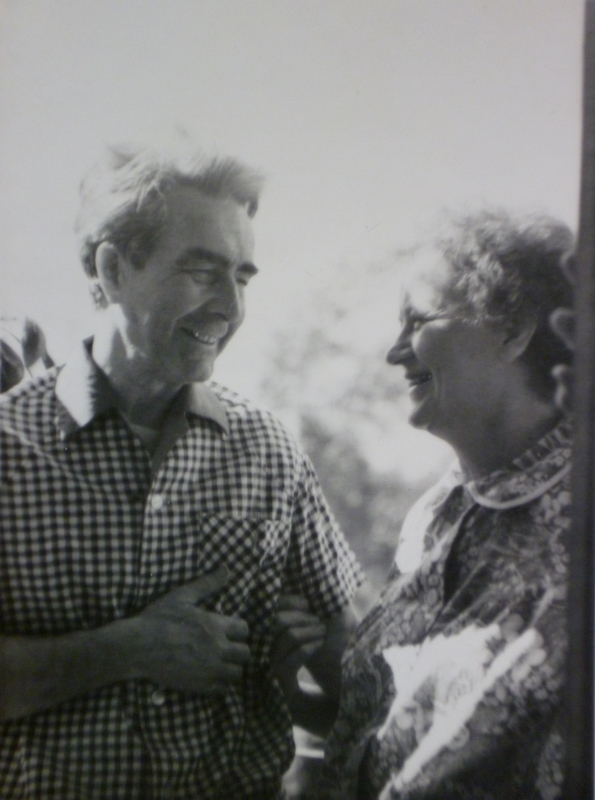
Vera Ivanovna and Sergei Ivanovich Avdonkin.
I admit that even before meeting Sergei Ivanovich, I had already taken active steps to look for a source of high-quality recordings, literally in the very first weekends of my first autumn in Petersburg. I met music lovers in Gostiny Dvor. I recorded several reels in exchange for clean PE-41 tape reels I had brought from the range, from my own cutting—so to speak, reel for reel. I went to a vinyl record push near Apraxin’s courtyard. On the second visit I mustered the nerve to approach what seemed a carefree young dandy with a large transparent bag, clearly showing a colourful envelope with the image of Count Basie’s orchestra. I nearly trembled with desire. I went up and asked straight out, ‘How much is it, comrade?’ And the comrade, without turning his head to me, answered in a half-voice: ‘four fifty.’ Something abruptly made me stop any further clarifying the deal, and I walked away, baffled. At that time a new Soviet record with imported music cost exactly three rubles. Well, of course a real imported record brought in by sailors could not be that cheap. I went back to the melomaniacs to be enlightened: ‘Multiply by ten in your head!’ It was not within my budget. For example, the very recently released first record by Boris Rubashkin cost 120 rubles. Three quarters of my pay. I never went to Apraxin again.
Naturally, I waited for the next invitation to visit the Avdonkins as if it were a holiday. It seems Sergei Ivanovich also found me interesting. But my collecting of music could not continue for a very objective reason: the lack of quality equipment. At the root of this problem was the total poverty of Soviet officer life and mine in particular. Proper imported equipment cost unimaginable money, and the quality of Soviet tape recorders was far inferior to foreign ones. But then Sergei Ivanovich devised a devious plan: invite Lena as well and let her listen to the most striking stereo recordings herself. In a way, as bait. Lyona and I came together. Vera Ivanovna fed us a wonderful lunch; we had social conversation and quietly moved on to ‘our toys,’ as Sergei Ivanovich puts it. Lena casually put on very expensive and beautiful stereophones, while Sergei Ivanovich played a James Last quintet recording made with an especially vivid stereo effect. Last was the first to use a multichannel recorder for studio recording! I could see, the wife was hooked—ready for further processing. On the way home she agreed to buy a used ‘Grunding’ TK-46. Only a thousand rubles. We got it from her relatives in Ukraine. It was paid back over a year. At that time I earned 180 rubles a month, Lena about 70. As I remember, how I carried my beloved little one from Liteyny Square to my place on Ruzovskaya by tram. A fabulous machine and in excellent condition.
I studied at the academy with pleasure, and if not for frequent absences—interruptions linked to SKA matches and sports camps—it would have gone along without strain. I even managed to solder some things at home in terms of amateur radio work and actively worked in VNO (military-scientific society), experimenting in the department of pulse devices. A lot of hours were spent in front of the bright-blue screen of DESO-1. This is a monster on wheels, about two metres tall. A two-head electron high-speed recorder, model number one. A large reel of coaxial cable was used as its delay line.
In fact, it seemed that teaching listeners was not the main task of the academy but rather an appendix to more serious tasks and themes solved by each faculty. Our radio engineering department had its own AN-12 aircraft for field experiments. Especially worth noting is the well-organised teaching process at Mozhajka, with a complete absence of strict militarism in relations between the permanent staff and the listeners.
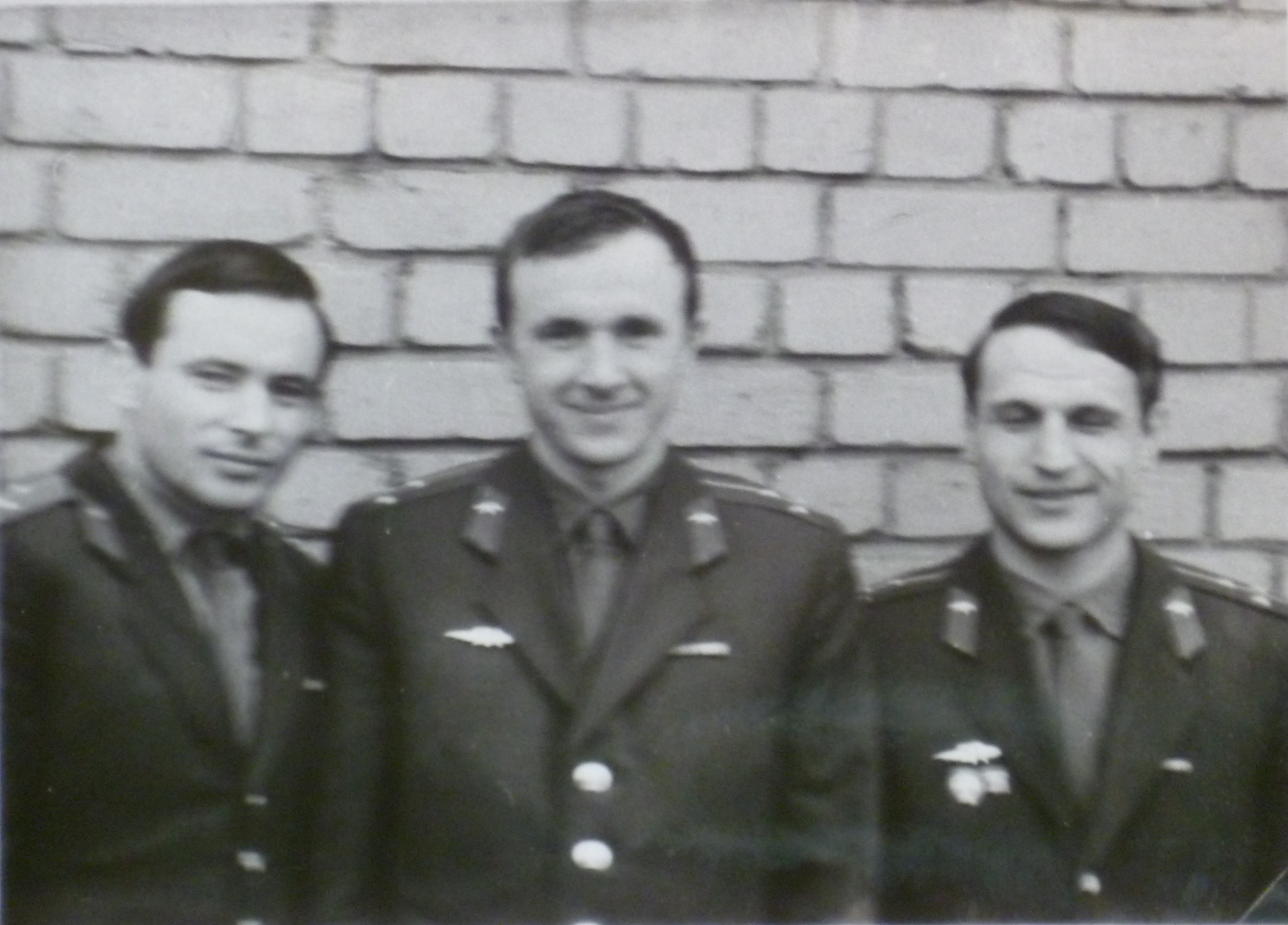
Lesha Podoprigora on the left, Vova Kochnev on the right.
The lectures themselves were, practically, almost never read by “sour-faced” teachers. All this democracy supported a good tone and mindset for study and humor; pranks and loud laughs accompanied the entire course. Yet once, it came close to playing a disastrous role.
And this is what happened. In the assembly hall, on some ceremonial occasion, the scientific community and all the command had gathered, and behind the academy flag near the presidium they set up an honour guard of two. I was put there too, together with Vova Kochnev. It turned out to be a very unpleasant job: to stand for half an hour in front of a vast full hall on some high plywood platform and hold a constantly heroic expression.
There we are, standing with Vova, standing and, without coordinating, almost synchronously and as unobtrusively as possible, with a turn of the eyes indicating to each other some huge, sweaty, pink, watermelon-round head in the presidium. My foolish mind was instantly taken over by uncontrollable laughter from within. And terrifying fear. That’s it, now I’ll burst out laughing out loud, I can’t hold it. I’ll be run out of the academy in disgrace! I think I even shut my eyes to suppress this relentless laughter trying to break out. Finally, the relief shift change. It turned out that Vova had gone through the same horror. Both fools had no room for laughter anymore. The next shifts were stood through in complete detachment from the presidium and we didn’t even look at the hall.
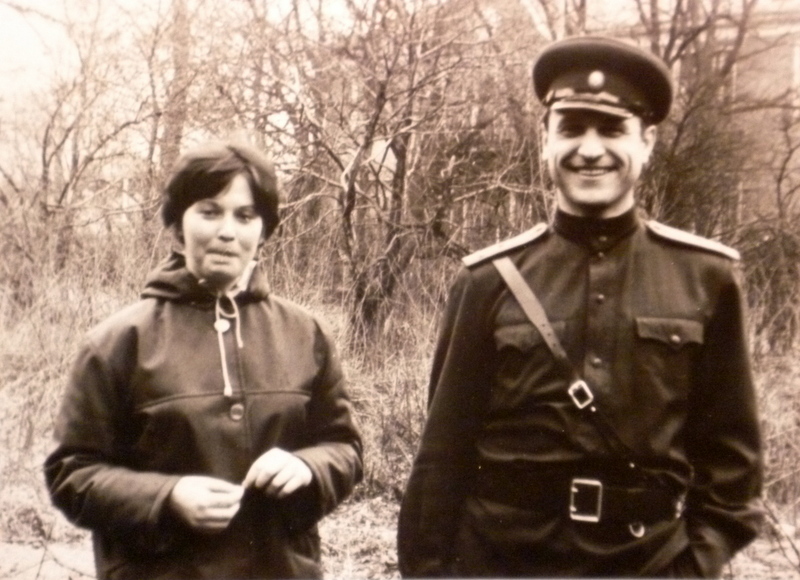
Nina and Vova Kochnevs.
In the summer pre-exam sessions we always travelled fishing with Vova Kochnev. Vitya Sysoev also joined us at times. How beautiful the surroundings of Petersburg are! Aspen woods, fir groves, and quiet water on rocky shores with separate picturesque heaps of boulders. Some sadness and calmness. Maybe this too helps form the character of a true Petersburg resident.
Relatives and close people came to visit. And my fellow servicemen as well. Over the whole period of study in Petersburg, I was visited by Lev Kostiuk, Farid Mukhammadov and Gena Pavlov. Consider it half a team.
I will not describe the beauty of Leningrad; it would sound banal, though from my first walks it already seemed to me I had felt the calm character of the northern capital and became its unqualified patriot. Among the most vivid entertainments I count the visits to Arkadiy Raikin. In those years, he was no longer performing very often in his native city. He had moved to Moscow. Tickets to his shows on open sale were impossible to buy. But my classmate and fellow Turyta Vitya Sysoev’s parents worked as ticket booth attendants. What fortune! The crowd on the day of Raikin’s appearance asks for an extra ticket at distant metro stations, while we, like proper gentlemen with our noses in the air, effortlessly with good seats, calmly drive to see and listen to our idol.
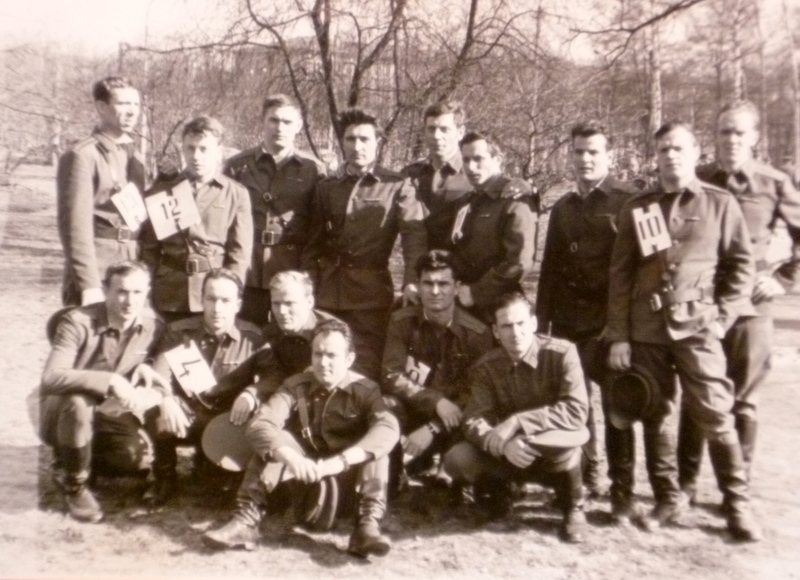
341st platoon after the spring cross at TsPKiO. I am next to Tolya Kurchev. Above me, the tallest and not looking into the lens, is Vitya Sysoev. Furthest right is Slava Schmidt. A tall brunette in the back row is Tolya Krutin.
Four years of study at LVIKA passed quickly, and the time came to decide on which range to continue my service, at the southern one in Tyuratam or the northern one in Plesetsk. I chose the northern. What determined this choice? First, the core of our Turytam team “Voskhod” over these four years left for various reasons and was reassigned from the southern range. Second, in the fourth year, in winter, the trainees go for a field internship. Our training department was sent to the Plesetsk range. I must say that in the department there were only two people from the Turytam range, Vitya Sysoev and me, and we felt very confident about any internship and even a posting after graduation. The rest of the people were visibly nervous, frightened by somewhat exaggerated stories about the ‘horrors of Tyuratam–Tama.’ I think it even scared them to hear that unpleasant-sounding phrase. Of course I would rather have visited the familiar steppe expanse of Tyuratam, but one has no choice—we go where they send us, to the unknown North. Mid-December, winter in full beauty, firs, pines, birches, leafless larch and other wooden charms along the railway. Immediately we were brought onto the range’s IP, our main workplace. It is several substantial buildings, some topped with white antenna domes of various sizes. Beautiful! All the buildings, as well as the internal roads, are amid mixed taiga with a predominance of firs. Everything in the purest white snow and without the all-pervasive steppe horsefly noise. A soft climate. Here the local “desyatka,” called Mirny, is much smaller than Leninsk by several times but very clean and tidy. And very importantly, excellent prospects for fishing and hunting. By New Year we returned to Petersburg. From the first days, I fell in love with the climate there, the taiga, and a winter with moderate frosts. An important and practical factor was affordable housing, unlike at the southern range. And to civilization, to Moscow, twice as close as from Tyuratam.
I received an assignment to continue service as the commander of telemetry station Tral-K2N in military unit 14056.