Chapter 25 of 29
Polyarnye Zori
In the autumn of 81, my father comes to visit us, and the two of us travel to the Kola Peninsula, invited by his old friend from Chelyabinsk-40, to hunt and fish. Lena prepared a couple of ducks we had bagged the day before for the journey, and in the carriage all the way to our station it was just Dad and me, along with two conductors, traveling in style. From Plesetskaya Station, we take our almost meridional railway toward Arkhangelsk as far as Obozerskaya Station. Then we turn left, in the direction of Onega Bay in the White Sea. Maloshuyka, Malenga, Virma. At Belomorsk, our railway meets the Leningrad–Murmansk line. We pass Kem, Vonga, and countless other picturesque little stations. From the carriage window, one can periodically see the open sea and the most beautiful coastline. Yet there is no tearing one’s eyes away from the spellbinding views of stone screes, cliffs, and uplands on the left either. And forests, forests in bright autumn colors. The poles of the telephone-and-telegraph line running alongside the railway are not sunk into the ground but encased in mounds of large boulders. Get off at any little station and rest your soul. Ah, the state-run life. If only I could live for half a year as a wandering traveler—I would settle on the Kola Peninsula for sure. At Polyarnye Zori Station, formerly Zasheyek, Mikhail Stepanovich Dorokhov meets us. In Sorokovka, he was a young specialist, having just graduated from a technical college and been assigned, together with a group of fellow students, to the most honorable work of producing the first Soviet atomic bomb. The work proceeded at a mad pace, day and night, with a deliberate disregard for safety precautions. Individual dosimeters were provided and control logs were kept, but, according to Mikhail Stepanovich, everyone cheerfully abandoned their dosimeters in cupboards and desks. There were 22 employees in his group, men and women. Under the heightened secrecy regime, they were housed near the facility.
When they began manufacturing the second device, people began quietly dying off. The entire group was taken off the production line and treatment was started. Of the 22, only one woman and Mikhail Stepanovich survived. They pumped about 150 liters of cerebrospinal fluid through him alone. He lay in Moscow, at 6 Govorov Street (the clinic treated Chernobyl victims), for about two years. He still goes there every year for preventive treatment. My father’s story about an ordinary routine production episode illustrates the “sanitation” of the nuclear arms race and the disregard for one’s own health. In one of the buildings, at a very “dirty” purification stage, some pump seal began to leak. The building was hermetically sealed, with very thick walls so that the “dirt” would not escape outside. Winter, bitter cold. By a small breach in the wall, a doctor in a white coat over a quilted jacket “dances” with a stopwatch in his hand, while a lightly dressed young man stands nearby with a coat thrown over his shoulders. A similar young man crawls out through the breach and, without stopping, runs toward the neighboring barrack, shouting as he goes: “There are two nuts, I unscrewed them!” The man who had been standing with the doctor throws off his coat and climbs into the breach. After 15 seconds, he too will jump out, run to the shower, receive a chocolate bar, and his working day will be over. No spacesuits, gas masks, or any other respirators with changeable footwear.
Mikhail Stepanovich’s brother worked almost until retirement operating manipulators. Naturally, with radioactive substances. He said that he arrived at work in whatever he was wearing, worked his shift, and went home in the same clothes. That was how people worked in the early years in Sorokovka. Mikhail Stepanovich showed us his membership card for the Khimik sports society. A young man with a huge black mane of hair gazes out from the photograph. Like Georgy Dimitrov—or perhaps the Marxist Zinoviev. And the man holding it has an absolutely bald skull. They awarded him the Order of Lenin and put him in the 2nd disability group. And with that, no one would hire him for any job. He lived in poverty for a long time, but somehow managed to change the second group to the third and finally found work at the Kola Nuclear Power Plant. Good pay, wonderful hunting and fishing grounds. Only his health was not so good. All that remained was his voice, with diction no worse than Levitan’s.
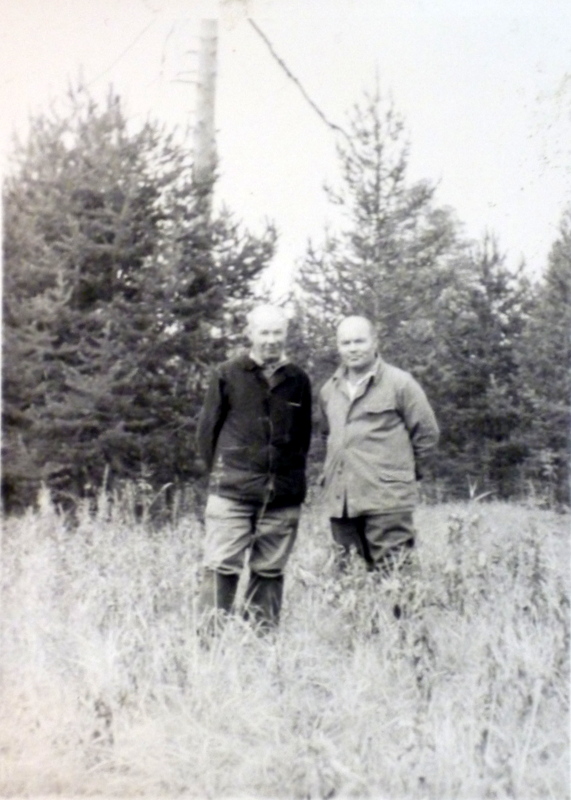
Dad with Mikhail Stepanovich.
And he invited us because he was launching his Amur-M boat. The first boat of this type on the entire peninsula. It had been brought to him from Leningrad.
Returning to our meeting at the station, I want to tell you about his dog, Aina. We get into a Zhiguli, into the back seat. In front, sitting like a passenger with her paws propped on the dashboard, is a huge shepherd dog. She pays us no attention whatsoever. It turns out she is not a shepherd dog but some kind of Laika. Mikhail Stepanovich had completed cynology courses, and this Laika was going to help him hunt bear. We set off for the atomic workers’ town. The one time I merely grabbed the back of the driver’s seat, I immediately received a snarl and a flash of young teeth. Stepanich stopped by some shop, and the three of us remained in the car. Us and the Laika.
We sit there, making plans. The moment we raise our voices even slightly, a huge muzzle turns toward us and says, not loudly, “Rrrrrrrr.” So we fell silent until her master returned. We sat like that, without uttering a word.
The next day we went to the garage. It was a palace, not a garage. An enormous hall, with a handsome boat on a slipway at one end, while three Zhigulis could fit along the opposite wall. The walls were painted pale green, with side lamps spaced almost every two meters. Electricity in the town was free. Heating-system pipes ran around the perimeter. This was the standard garage-boathouse of NPP workers. An automobile crane and a trailer delivered the boat and lowered it into the water, and without delay we began its shakedown run. The Amur had a converted Moskvich engine and a spacious cabin covered with canvas, furnished with comfortable upholstered seats. Everything we needed for a short trip was ready. It grew dark, stars appeared in the black sky, and a beautiful aurora borealis emerged. You never see anything like that around Plesetsk! Some magician began quickly and softly drawing various flourishes with a felt-tip pen across the cloudless black sky, right over the stars. And all of it was reflected in the black water as well. Then the weather began to change. Fog covered the surface of the bay. We switched on the bow searchlight and finally lost the shore. Everything was milk-white, and even the sounds somehow began to ring differently—or perhaps it only seemed so. We puttered around blindly at low throttle for a while. It was extremely uncomfortable. We anchored and, after waiting for dawn, returned to our berth.
The following day was spent preparing for a serious journey and examining the weapons collection. Besides hunting guns of various systems, the collection included a PPSh submachine gun and a Schmeisser. The collection was legal. “And what rifled weapon do you have?” MS asked. My answer was met with an indefinite “We’ll think about it.”
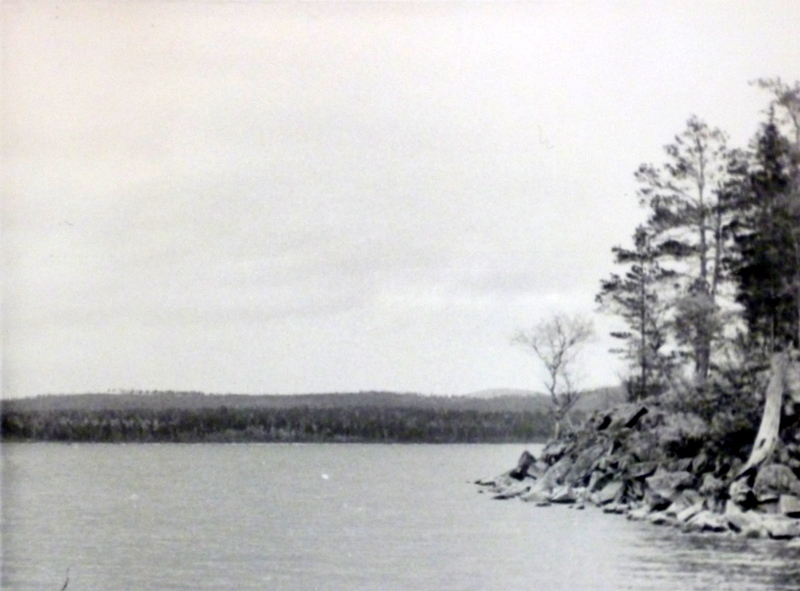
The next morning, the five of us—that is, including Aina—climb into the familiar gamekeeper’s Kazanka, and for about three hours travel under a Veterok-8 through the bays of Imandra. More precisely, through a system of lakes. And where they clearly look like bays, they are called lakhtas. Water, water, and steep overgrown shores—grivy, as they are called locally. At last we ran into some griva and began unloading. A great deal of gear and provisions. As for weapons, only my double-barreled shotgun and a five-shot MC21-12 automatic rifle. The gamekeeper explained how to find his hut, located on the other side of the griva. He told us where his two nets had been standing for two weeks and asked us to take them down and wash them. He gave us a packet of washing powder for that purpose and promised to return for us in a week.
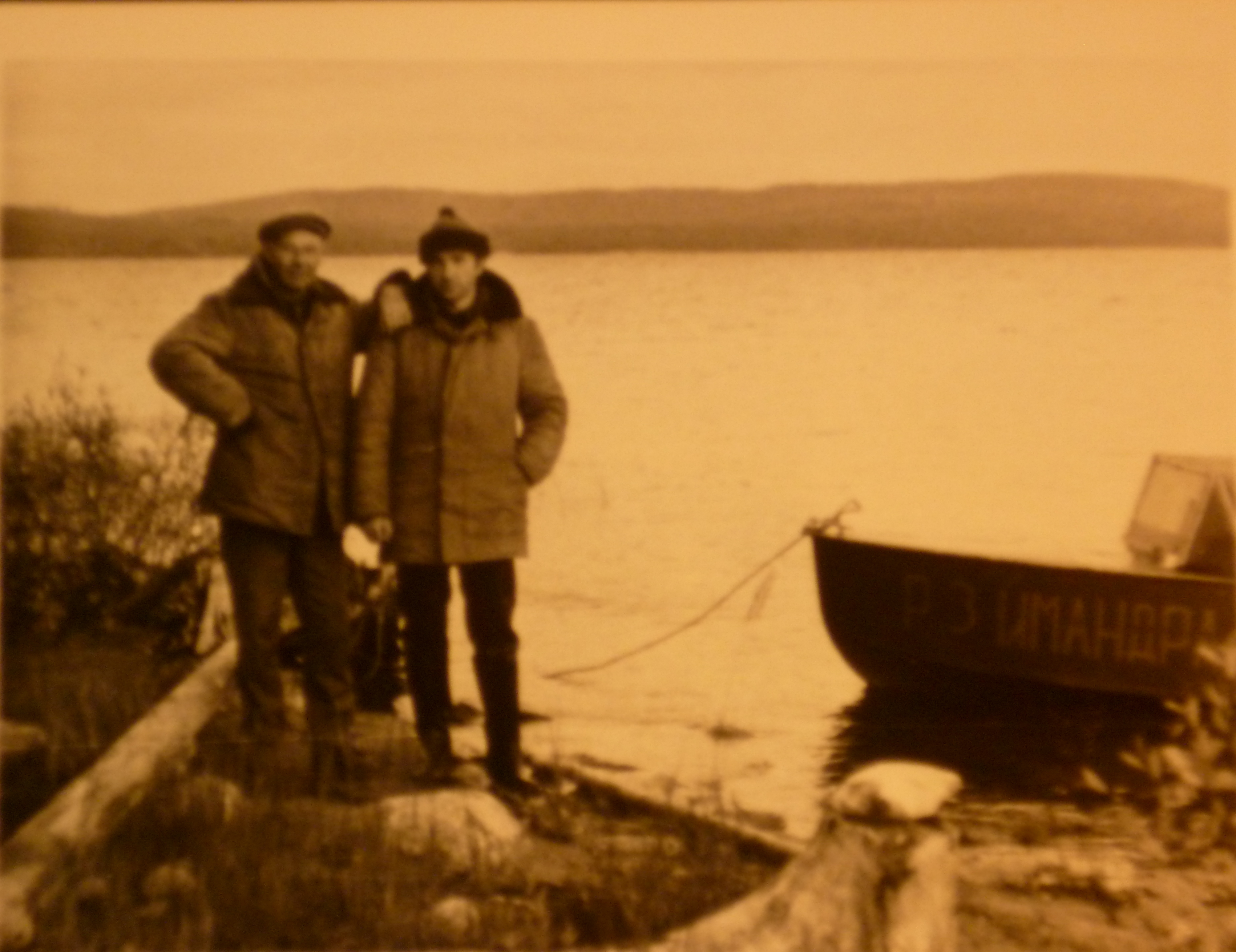
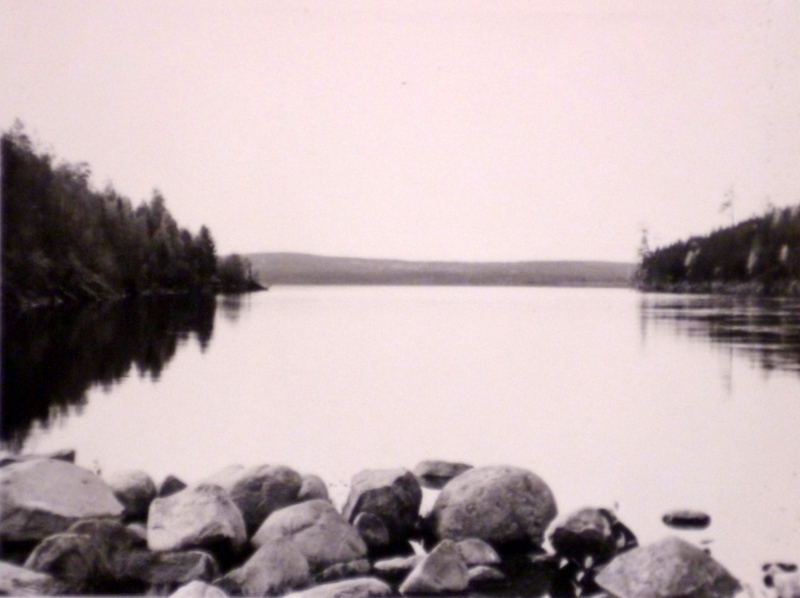
By the gamekeeper’s boat. Imandra Bay.
We sawed through a large bottle of Gamza with him by the boat for the road and waved him off. A serious and reliable man.
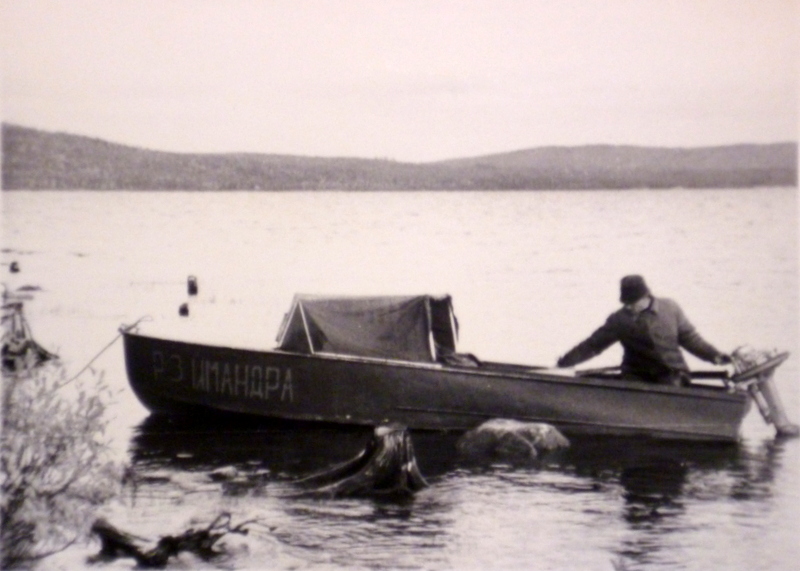
We lugged our gear to the hut. What a glorious view opened before us from the griva! The dugout was half-built into the slope, with one wall set into it, and no more than thirty meters from the water. Good bunks with mattresses, all the dishes, a huge cauldron, and even a new inflatable boat. There was no need to arrange anything. We looked around, had supper, and went to sleep. In the morning, with daylight already at the window, Aina asked to go outside. And immediately, almost from the doorway, she began barking. MS says to me: “Take the gun, there’s something there.” I go out and see a capercaillie sitting at the top of a pine twenty paces from the hut, studying the noisy dog. Without delay, I bring it down, but it does not reach the ground, getting caught in the branches. My fathers come out and congratulate me. But the dog is needed. We found a small ladder on the roof, and I climbed the tree and shook the quarry down with a stick.
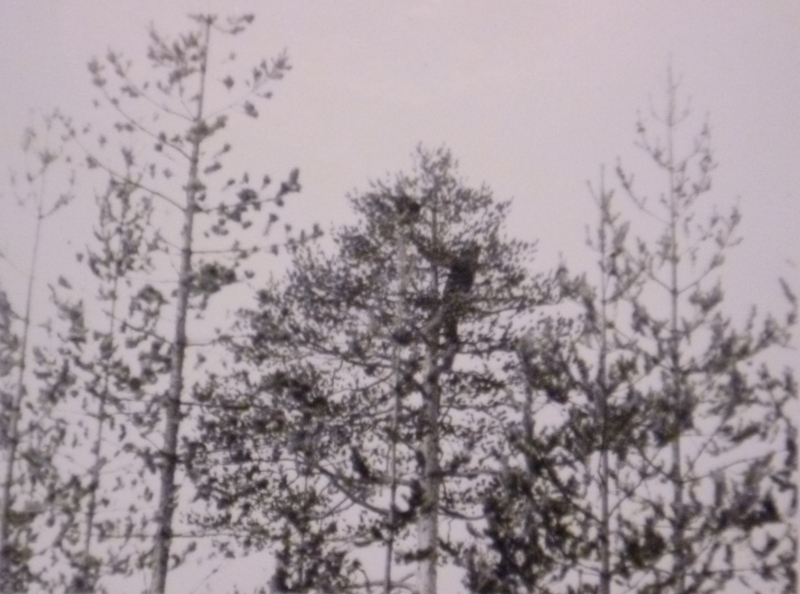
Over breakfast we learn that dogs of this type of Laika work exactly this way with woodland game. A good dog must control the hunter’s behavior and, without excitement, distract the bird continuously. The weather is wonderful, and we set off together, unhurriedly, on what you might call an introductory walk. The griva is fairly evenly covered with low pines. There are not many deciduous trees. Underfoot is white moss and some large black berries—the bears’ favorite delicacy. You cannot call this forest taiga at all; it is far too clean and airy, more like a park. Lemmings are very common. They are fairly large mice, distinguished by astonishing fearlessness. I stand over a burrow from which a toothy little creature half emerges and then backs away again. All the while it squeaks and hisses continuously, trying to bite my boot. It is defending its home. Astonishing courage.
The three of us walk along and talk. I have an automatic rifle on my shoulder. Now to the right, now to the left, at a distance of 50-70 meters, the red-haired Aina flickers into view. We had gone no more than a couple of hundred meters when she barked ahead. I go on with the instruction that if it is a squirrel, she should bring it down. The dog is young and needs training. I see Aina, and most interestingly, I see that she really is keeping an eye on me. She barks rarely, her muzzle raised at about 45 degrees, so I have no trouble finding the capercaillie. Without hurry, using the trees for cover, I approach within reliable shooting range. The dog, without changing her position, continues barking a little more frequently, glancing at me… The capercaillie is on the ground, and the dog, for form’s sake, gives it a little shake by the neck. Clever girl! We tie the capercaillie to a stick and carry the trophy on our shoulders back to base. It turns out that with a dog like this, the main problem is carrying out and preserving the game. My father, an old hunter, told me confidentially that evening that he did not like this kind of hunting at all. It resembled murder. But there would be no problems with provisions. We still had not checked the nets.
We inflate the boat and cross the bay. The shores and bottom are rocky. We find a landmark and troll with the grappling hook. There it is—we’ve caught on, we haul it up. But what is this? Suddenly rainbow-colored oil slicks begin rising to the surface of the water, and our noses detect an unpleasant smell. We haul up the net, and it is crammed with fish of varying freshness. Some of the fish simply break in half. Huge burbot, pike, and char. What a stink. We shake it out, collect both nets, and paddle off to wash them.
A day later we set one net and then had no idea how to cope with the catch.
At exactly the appointed hour, our gamekeeper arrived, the rain promised by the forecast finally began, and we made it home half-soaked.
It was truly an unforgettable journey. We visited a remarkable man and traveled by train through the most beautiful places. Get off at any little station, pitch a tent, and enjoy the beauty of northern nature.
We put Dad on the train, and I returned to my service. By then the snow had already fallen. I received a notice about a parcel. I went to the post office, received the stub of the form, and read: “I am sending a spinning rod; I will send the lures later. Dorokhov.” The postwoman thrust a narrow, long plywood box at me. I took it. Heavy, weighing about five kilograms. I immediately understood and remembered that conversation. It was frightening even to carry this unknown weapon through town. I unpacked it. Mother of God, it was a Tokarev self-loading rifle. True, without a magazine, but in all its menacing glory. Chambered for a powerful cartridge, standardized with the cartridge of the Mosin three-line rifle. About a week later, the “lures” arrived.
There was nothing to do, so I fitted a telescopic sight and took it to a quarry near Medvezh’i Gory to sight it in. The sound of the shot was two or three times more powerful than that of an automatic rifle. It seemed the whole range would come running to watch. But I managed to bring down nothing with that cannon. As Plesetsk hunters say, moose, as if on purpose, turn up on a hunt when you do not have the necessary stick with you.
In their jargon, a “stick” means a rifled weapon, a rifle.