Chapter 27 of 29
Holidays
Every Soviet person has the right to his lawful annual leave. But a military man from a remote garrison can hardly wait for those thirty days. And here it is not really about a portupei and boots—the test engineer wears them rarely. The main thing is that during those days you can take off the built-up psychological tension, and simply get some basic rest from the boss’s nagging faces.
Until we got our first Zapor for leave, to the mainland we used to travel by train, to Moscow and beyond. Everything changed when we got a ZAZ-968. Our very first trip by car we spent together with seven-year-old Tania. Lena’s leave did not coincide with mine. Now there are no problems leaving Mirny for the mainland. In the North, at last, normal roads appeared. And in those times, a trip beyond the test range, and especially toward Vologda Oblast—that is, in the southern direction—required serious moral and technical preparation. Prudent road travelers gathered together and transported their cars to the mainland by rail platforms. That did not suit romantics. When setting out on such an off-road expedition, you had to bring a reliable shovel, better two, to dig the car out of mud, a saw, a large axe to saw and road the way, a long rope, a reliable winch, a ground anchor-plow, two thick, wide and long boards—for getting on and off the ferry. It so happened that on this first trip by car I did not take the boards, and I immediately paid with a bent fender skirt and the Zapor’s exhaust pipe. The very first ferry did not reach the bank by about seven meters; it struck a gravel bank. People shouted, give it some gas and jump. But I was too scared to add the gas, so I went nose-first into the water while the rear part stayed on the ferry. The seasoned folks immediately pushed from behind, and I, like a steam boat, inched to the life-saving shore. Lesson for the future.
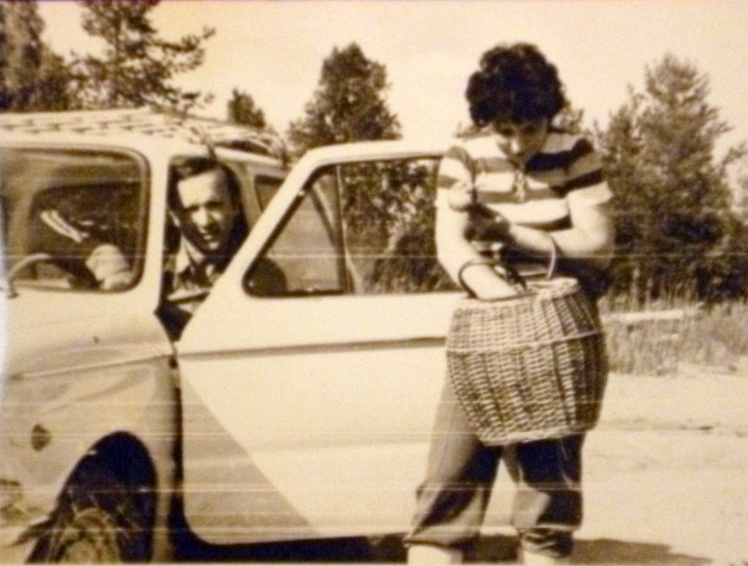
We headed to Moscow, then to Kalinin—now Tver—to visit the Kostiuks, and also brought Lev a six-seat rescue raft, the PSN-6. I bought it foolishly for fishing fun, but it turned out to be completely immobile and ridiculously heavy, 68 kilograms. But it was made well.
The weather was lucky: we reached Kalinin without incidents. Tatka kept a diary all the way, recording every populated place without exception. We rested at Lev’s and set off to Ulyanovsk, to parents in the city of Melekess, now Dimitrovgrad. We had a good rest, fished, and headed back through Moscow, Yaroslavl and Vologda.
We are approaching Prokshino, which is the beginning of a forty-seven-kilometre segment of ownerless land between Vologda and Arkhangelsk oblasts. The adventure-seekers on leave who dared to travel for vacation in their own cars call it the Road of Life. And right there a thunderstorm with a downpour began. As if on purpose, at the moment of clearing the very first serious hole, the roof rack fell and all four posts broke at once. On that rack there was a folding wooden boat, and under it a pile of jam jars. It was good that there were many ropes with us. I propped in some supports and wrapped the whole car like a spider web, so only the driver’s door could open a little. Slowly we crawled to Mirny. But not always did things go so smoothly. Once we still got stuck on this ‘highway’ for almost a day. The leave fell in early June, the roads still had not dried properly after the snowmelt, and the three of us—Tanya, Lena and I—were simply worn out, dragging the car out of endless pits. Once again we got seriously bogged down. The road mud was level with the thresholds; another centimetre and it would flow inside. We were exhausted like devils, and night had already been out for a while, though it was the white one.
We washed our hands and had dinner. We began to settle down to sleep in comfort. Tanya in the back seat, mamanya on the right, I at the wheel. Everyone sat upright because the car was packed to the brim with junk. At last I took off my swamp boots, rolling up my lower legs, and left them outside, because it began drizzling. We were so tired that no one even swatted mosquitoes. Just dozed off, then got a shove in the side from the navigator: ‘car, car, get out!’ We crawled out of the box and looked around. The road we drive on is on average about ten meters wide; on especially swampy sections it exceeds thirty meters, but this is no longer a road, rather a tangle of logs, split boards, branches, sticks. All of it sticks out or half-floats in small and endless puddles. Traces of heavy trucks’ struggle to survive. Where it is drier, everything is deeply rutted. The greatest widening of the road with turns into forest patches is on those sections where springs break out, and they are clearly visible on the slopes. We look forward, we look back, and there are no cars at all, only a plane buzzing high in the sky. Immediately it seemed as if we were drifting on an ice floe.
In the morning we got up unhurriedly. Why hurry, into which pit? We were still lucky; otherwise we might have spent the night with sludge in the cabin. Everything is relative. We felled a heavy log, dug under it, wrestled with the hubs, and hauled ourselves up. Elena Ivanovna has no equal here; no need to advise her. We got to solid ground and together decided to rest and wash. After all, we are on vacation.
About twenty meters from the car, on a small bridge across a tiny river, Lena started cooking lunch. I decided to walk a little further, past the bend, to look around. I walked about a hundred meters—I heard and saw a man chopping young growth under the communication lines. I approached and we talked. He is a linesman, clearing overgrown forest on his section. The trees were almost up to arm’s length. ‘Aren’t you just about to meet a bear? He crossed the road right in front of you,’ the man said, surprised. I returned. Right, in the mud were the tracks of his clawed paws. I called everyone over to admire them.
We persuaded the man to have lunch with us. We enjoyed talking with the worker-linesman, clearly living more than modestly on his salary. He could not cut down all this growth under his wires.
By evening, at last, some machine growled in the right direction. It was a Ural-375, carrying to Vologda for repair some electric motors. We quickly folded camp, attached the Zapor with two joined tow ropes, each rope 15 meters long. So that I could maneuver from behind and not dive into too deep holes in the wake of the Ural. And by the character of the waves, I can clearly see where one should not go and where to drive better. We simply sailed perfectly through these a little over forty kilometers—that is what a long towing end means! We stopped for the night by the Voya River. Lena got an abundant table and ‘it was all ours’. Great with northerners! They always come through, and they have no notion of magaryche. They cannot be compared with southerners.
We sat happily, and in the morning we saw them off, handing the boys some spirits. Then we bedded in ourselves and moved on too. Before Vologda we hid in the forest the planks, winch, ropes, shovels, saw and axe. Then we drove on a fairly decent road strictly south, to Vologda and Yaroslavl.
In general, on the Zapor during leave we managed to visit Tver once more, Dimitrovgrad, Ukraine, and the North Caucasus. Each time when coming to vacation in Ukraine, it was obvious the abundance and variety of products in shops. For example, in a shop on the station square in Cherkasy I counted 17 (!) kinds of sausage, while for us, as we thought, in the fairly well supplied northern test range compared to the nearby settlements, only varenka was sold and even for it you had to endure a long queue. And as for fish, there is nothing to say. In Cherkasy several fish-processing plants operated. They smoked, salted, and canned. Mostly using northern fish. And in Arkhangelsk and Plesetsk, they had already long switched from cod to pike.
In banquet-like, candid conversations, the straightforward villagers of Belozersk sincerely insisted that such a difference in living standard was only because of Ukrainians’ extraordinary work ethic. You tell them that there are peoples in the Caucasus living even better in our friendly Union of equal republics, and they doubt, they do not believe. And on this note, on this note of national exceptionalism, the ruhovtsy actively played during the time of power-sharing and confusion. The slogan: ‘Enough to feed the Union!’ strangely took hold of the hearts of my naive Ukrainian compatriots and, undoubtedly, influenced the outcome of the independence referendum. It is fair to note that the nationalists of all republics successfully fooled their peoples in those years. And the Zapor is a good car, only it breaks down often and constantly demands serious maintenance. It consumes a lot of oil and gasoline.