Chapter 6 of 29
Hoş Geldiniz! (Welcome)
This is how, traveling light, our military contingent arrived at Tyuratam station.
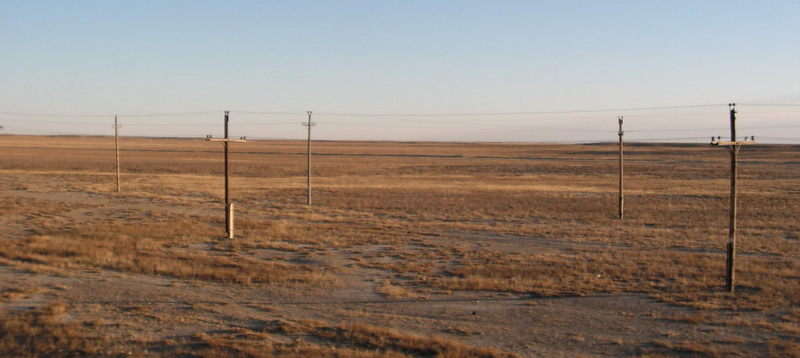
We are approaching Tyuratam.
A hot day at the end of September; with pleasure we leave the tiresome, burnt-oil-reeking carriage and take our first steps on Kazakh soil. What awaits us ahead? The impression is oppressive. A tiny, run-down, single-storey station building, whitewashed with lime, stands amid a disorderly scattering of huts made from railway sleepers, lightly and carelessly smeared with clay. Yet an unexpectedly large number of military men got off the train. Beyond the station is a square; buses drive onto it, raising clouds of dust. Everyone was seated and taken away. 15 minutes later we saw a completely different picture: beyond the hill, past the checkpoint, a modern city with asphalt roads, entirely planted with rows of young trees!
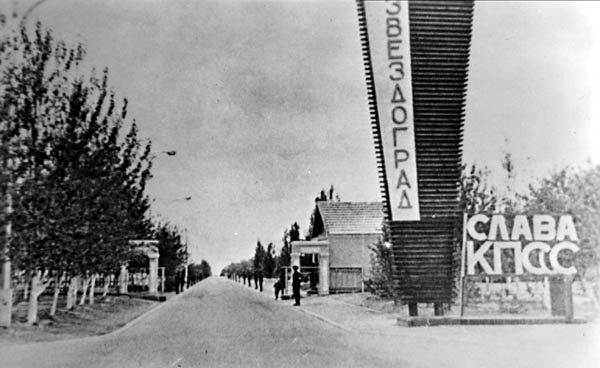
Checkpoint.
This is the “Ten,” Site No. 10, the residential settlement and the administrative and cultural center of the test range. Its official name is the 5th Scientific Research Test Range of the Ministry of Defense, abbreviated as NIIP-5 MO, also known as military unit 11284. And since “in the beginning was the word,” the test range was established by a Government Resolution of February 1955. My military unit 33797 was formed by order dated 26 February 1960 as BSS 69 (combat launch station) for combat duty with the R7 missile12.
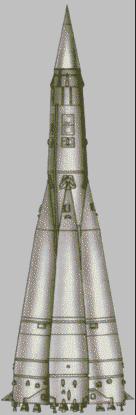
In the USSR as a whole, 5 combat units (BSSs) were formed, with 6 launchers. Two at Tyuratam and three3 at Plesetsk.
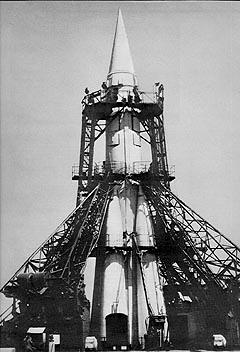
The “Seven,” 8K74
By the way, all residential sites at all Ministry of Defense test ranges bear the number 10, while cemeteries bear 13. For open postal correspondence, the address was “Kzyl-Orda-50”; before that it was “Tashkent-90,” and earlier still “Leningrad-400.”
At the test-range headquarters I was assigned as a technician to the SOBIS crew of the horizontal testing team of military unit 33797, Site No. 32. What the abbreviation and the numbers meant was complete darkness to me. My first night in the officers’ transit quarters—a soldiers’ barracks on the edge of town—was spent in a room with bunk beds, pillows, mattresses, and blankets, but no sheets or pillowcases. All the new arrivals found an empty bunk and, without unnecessary words, went to sleep, sleep. In the morning, a bus took us to this 32nd site, almost 56 km away. Everyone except the driver rode with their eyes closed; the dust was unbelievable, ultrafine, gray-yellow. Good asphalt roads had not yet been laid throughout the test range, and it was a stroke of luck to get onto a bus; for the most part, people traveled by train or in trucks under a tarpaulin canopy—or without one. I’ll tell separately, later, about traveling by train, or by motor locomotive, as it was called in the test-range jargon.
Aviators, tankers, signalmen, artillerymen, and sailors boarded the bus, but everyone got off in gray coveralls, with gray faces and gray forage caps. Even our eyelashes had turned gray and enormous. A nightmare. We looked around. Several 2-storey houses and a couple of dozen single-storey, barrack-like ones. A stadium made up of asphalted basketball and volleyball courts, an unbelievable number of horizontal bars and wall bars, a dirt football field, and a large open-air swimming pool. Some dusty construction work and a mass of soldiers who were either blackened by the sun or of Asian appearance. This was Site 32. Off to the side, on a prominent rise, 5 kilometers away, stood some enormous stone shed, roughly a hundred meters long and fifty wide; farther on was another equally enormous but utterly incongruous structure. They explained: it was the launch facility. The shed was the MIK, the assembly and testing building, also known as Structure 14. There the product’s stages were unloaded from the railway cars, the rocket was assembled into a package, all types of autonomous and integrated horizontal tests were conducted, and the product was taken from the MIK to the launch facility. An automobile road and a railway led to the MIK and the launch facility. Everything was enclosed with barbed wire, and at the entrance stood a substantial checkpoint with a guardroom. The MIK and the launch facility formed Site No. 31, the place of my future service.
To the left of the stadium stood a miniature Pulkovo: two domed astronomical pavilions, painted brown rather than the customary green, and several squat structures. This was the flight radio-control point, PRU, Site No. 33. Radio antennas stood beneath the domes. The 33rd site, like the 32nd, lay from the 31st, the launch-and-technical site, about 5 kilometers away. It was on these three sites—the 31st, 32nd, and 33rd—that my military unit 13991 was stationed and operated, carrying out its combat missions.
They put me in a two-storey hotel, on the ground floor, in a corner room. We were changed into field uniforms, the so-called “mobutovka”: khaki trousers, a short-sleeved shirt, and low shoes; on our heads we wore splendid velour hats with wide brims. No ties or Sam Browne belts, only a wide waist belt. (A couple of years later a new defense minister arrived, Grechko, a cavalryman, and abolished this uniform; he disliked the hats.) We began to shine in the heat with polished boots and Sam Browne belts. A wise minister, after all—a member of the Politburo!
I was assigned to the SOBIS crew. The crew belonged to the horizontal electrical testing team, and the team in turn belonged to the second group, headed by Major Vladimir Yemelyanovich Gogsadze. The group of autonomous and integrated horizontal testing. Let me say in advance that I was lucky to have good and intelligent commanders.
Every day, apart, naturally, from duty details in the unit, we studied the Bottle and Glass Emptying System—the popular interpretation of that same SOBIS. Its exact name was the Block Emptying and Component Level Synchronization System. The system’s task was to minimize the rocket’s guaranteed fuel reserve. The R7 rocket, as is well known, was a package. Each stage had its own engines. Each engine had its own character, and in flight the rocket was also subjected to various disturbances. Fuel and oxidizer were poured into the tanks with allowance for these possible deviations from the standard flight mode. When the flight program was calculated and, accordingly, when the tanks were fueled at the launch site, a calculated reserve of propellant was added. In flight, SOBIS monitored the fuel and oxidizer of each stage so that they were consumed in the required ratio and the entire package—the four side boosters and the central stage—was emptied synchronously. The crew chief was Yuri Alexeyevich Gubarev. I remember Yura Sivitsky, Yura Arkhipov, and Valera Makhnykin in the crew. Everyone in the crew, headed by our chief, was remarkable and dependable. In the list of my best friends and comrades, they occupy the top lines!
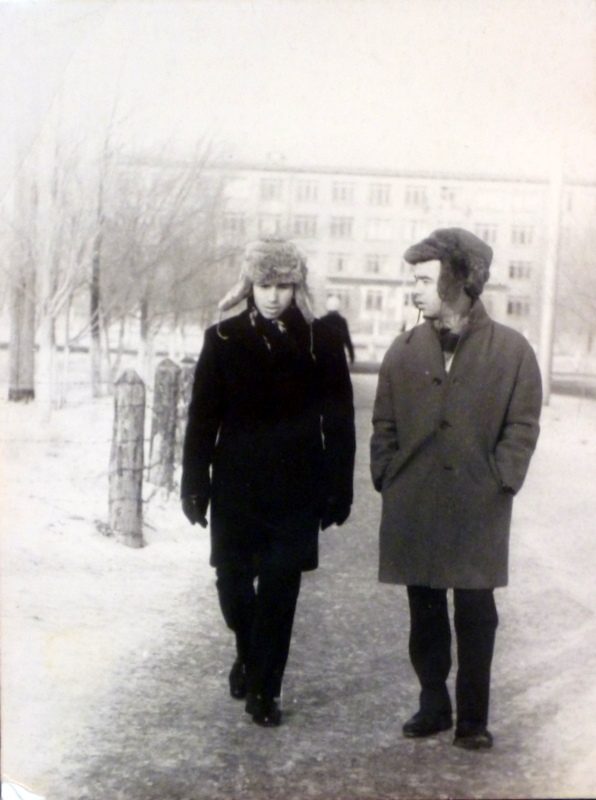
Valera Makhnykin and Farid.
After aviation, everything was unusual, even strange. Detailed, painstaking testing. Quite a lot of failures during product preparation, followed by a sufficiently lengthy search for and analysis of malfunctions, down to the smallest detail. But compared with the other onboard systems, SOBIS stood out for its exceptionally rare failures. That was, of course, due to the scientists and industry that had created the system.
From here on, I’ll try to tell not about the service—it went on as it went—but mainly “about life.”
The room for us young newcomers was a corner room, with a window facing south. Three of us were housed there: Valera Timonin, Olkhovsky, and me. All Irkutsk natives. In truth, after a couple of months I was left alone. Timonin and Olkhovsky transferred to the “bigheads”; accelerated expansion of the staff was under way at the 38th site, where the pay was higher and the distance to the “Ten” was half as great. An “old-timer,” Vladimir Mikhailovich Ambrosovich, a senior lieutenant-engineer at the radio-control point, immediately moved into the vacated room; he was also known as “Vol.” During the summer we tried to keep our room’s window closed whenever possible, so that phalanxes and ubiquitous mosquitoes could not get in. Every morning of my first Tyuratam summer began with an inspection of the sky to see whether any clouds had appeared. Not a chance. Korolev had not been mistaken in choosing a cloudless region for his test range! It was a little wearing. And then, throughout the day, there was the constant search for saving shade from the sun. I did not even feel like trudging through the furnace heat to the dining hall. Although there, an almost obligatory fruit soup awaited us—cold and very tasty. It was “wonderful” when Bes-Kunak blew during the day: a hot, dusty wind. Then all the dining hall food, starting with that marvelous soup, crunched between your teeth.
It was impossible to buy a fan; they were in short supply. Most often, people brought them back from leave. A few lucky men owned small ones, hot to the touch and buzzing terribly loudly, with three-bladed plastic propellers. The owners of large “sycophants” could be counted on one’s fingers.
It gets dark quickly, and there it is—the saving night. The time of cicadas, crickets, beetles, and every kind of spider and little spider. They have such respect for walls heated during the day. They cannot stay on the ground; they keep trying to come inside as guests. You take a shower a couple of times. Wet your sheet. “Lucky” is the man who has knocked back a drink in the evening. He will sleep soundly. One morning I woke up, and Vol was asleep in his bed in a strange position. His head was on the pillow, but his body formed a letter G, with him kneeling. And he had hardly drunk anything, he later protested.
I went to the “Ten” rarely; I had not yet acquired a personal bunk in Dormitory No. 2, not far from the department store. I led a “sex life,” that is, I spent the night at acquaintances’ places, sleeping on the floor. Dancing and films at the Officers’ House. It is time to describe my wardrobe. One pair of trousers, hideously tapered in accordance with fashion, so tight that one could barely get a leg through; a couple of shirts, at first cotton, and later, by good fortune, a modern, fashionable synthetic one. Because in those years wearing cotton was old-fashioned, unfashionable. Those nylon shirts, like modern synthetics when worn, were of course rubbish. They scratched, built up static, and absorbed no sweat. Several pairs of socks, but one pair, as I remember to this day, was bright red. Fashion, too. Some sort of black jacket. In 63 or 64, the first collarless jackets appeared. Tolya Kornienko was the first to own one, and Giza probably the second—the most fashion-conscious fellows in the unit. As for ties, I had several, left over from my father. Then several more were added, and even a couple of bow ties. That was for special flashiness. One unchanging pair of black shoes. A new overcoat of an indeterminate, probably gray, color, and a gray velour hat as well. Naturally, with a small brim. And so dressed, we headed to the Officers’ House. I was dressed no worse than the others, though no better either. In fact, appearing at a dance in military uniform was considered bad form. And on the second floor, above the lobby, the garrison orchestra thundered and groaned—naturally without a string section, but with a quite respectable brass section led by an indefatigable conductor. The dance hall was large, but there was never enough free space for the couples, especially those dancing waltzes. But who paid attention to such trifles? Or to the party slogans lavishly decorating the walls of this temple of culture. In the bright little eyes of the young people, party members and otherwise, the watchdog organs and political officers read entirely different thoughts and desires. Sometimes, and later regularly, the test range received distinguished guests—stars of the stage and cinema. I think that every one of them eventually made an appearance at the cosmodrome. Although during my years there, this was a cultural event.
There was one tavern in the whole town—the Berezka Café. The strongest drink, and the only one, was Moldovan wine, “Vin de masă.” In popular parlance: “pour it out and piss.” In fact, it was not a bad drink. Thirst-quenching, and nothing more. On weekends, various sporting events were usually held. The people in the units were mostly young, as in all the missile forces; the average age was 26, and the sports grounds in the park were never empty. A large stadium was being built at speed; its football field was covered with black earth brought back from yet another autumn expedition to the virgin lands. Throughout the vast country, every unit, at the end of summer or even at its beginning, sent equipment and people away from their service to the notorious and already-lost “battle for the harvest,” begun at the dawn of Soviet power. That was because, in accordance with the false teachings of the Ulyanov fanatic, the Communists first destroyed the genuine village laborer, and then, through collective farms and the loudest, most impudent “activists” from among the poor or the idlers who came to the Kremlin and to local party committees, grew a multimillion-strong army of indifferent and thieving “collective farmers.” And it was precisely these collective farmers whom the army, factories, and schools and universities helped. What else could one do? If you refused to go, you handed over your party card, my dear fellow. Serves them right, those Commies.
At our 32nd site, nobody offered much in the way of entertainment, and there was not enough time for anything anyway. Books, music and radio, a tape recorder, amateur radio, and sometimes evening films at the club and dances. In the evening, after dinner, grabbing a packet of wafers or a jar of compote—usually Hungarian apricot—I trudged to site 31, to my SOBIS laboratory. Its large worktables were covered with high-class measuring instruments, exactly what I needed for tuning my contraptions. Silence reigned in the large room and throughout the enormous MIK building. Sometimes I stayed there until 4 a.m. I closed up shop, quietly passed the half-asleep duty officer, and half an hour later, in my dormitory, dropped onto my bunk beside “Comrade Morpheus.” During the first years, all radio amateurs suffered from a shortage of radio components. The spare-parts kit was off-limits; emergency rockets fell far away. Whatever could be bought was brought back from leave. On one occasion or another, there were friendly drinking bouts in the very warm company of the 2nd group, in Dima Tropin’s room, or at home, just the two of us, with Vol. But in first place, naturally, was handball! They elected me captain. The team was called “Voshod,” after the satellite.
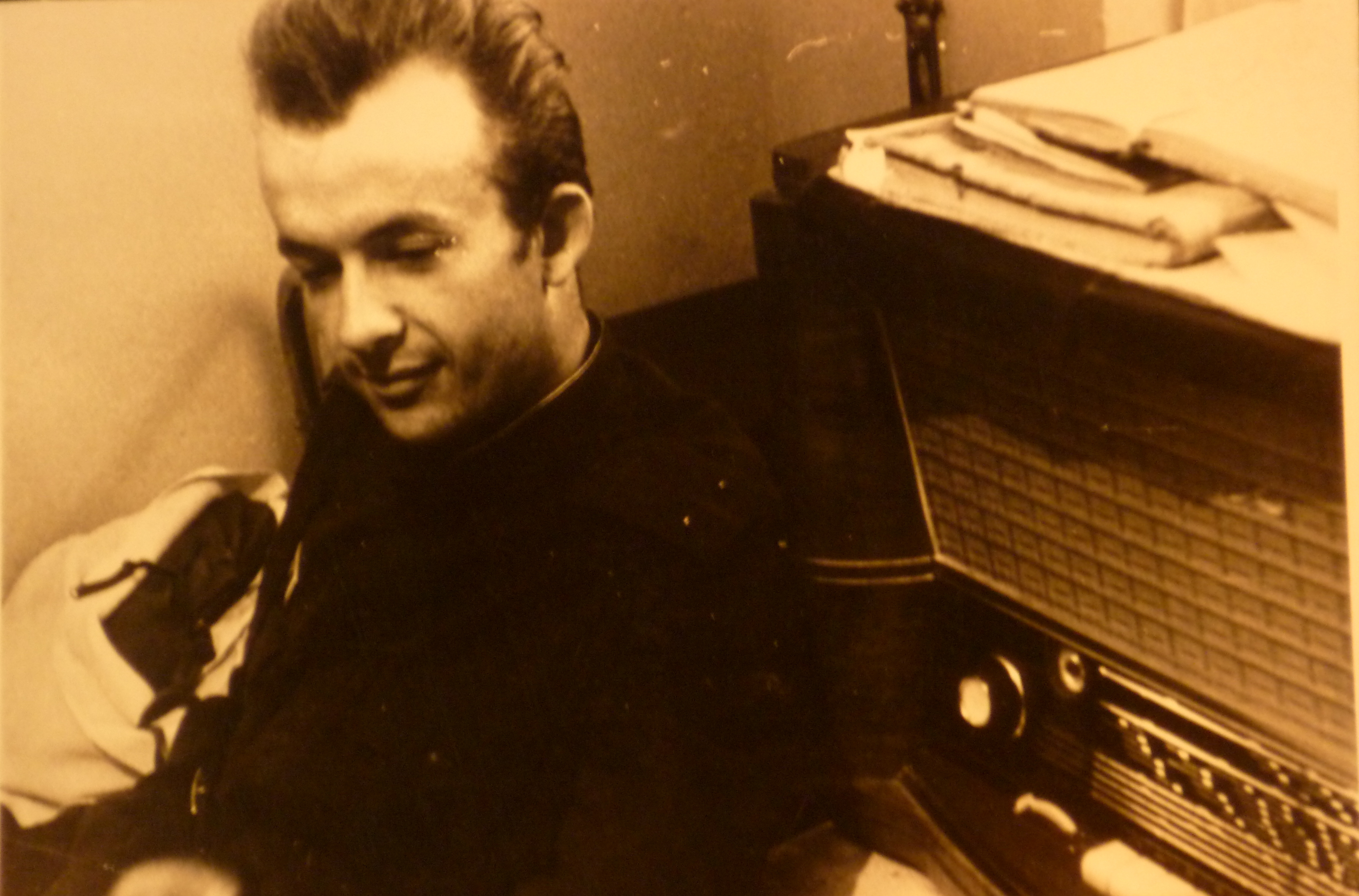
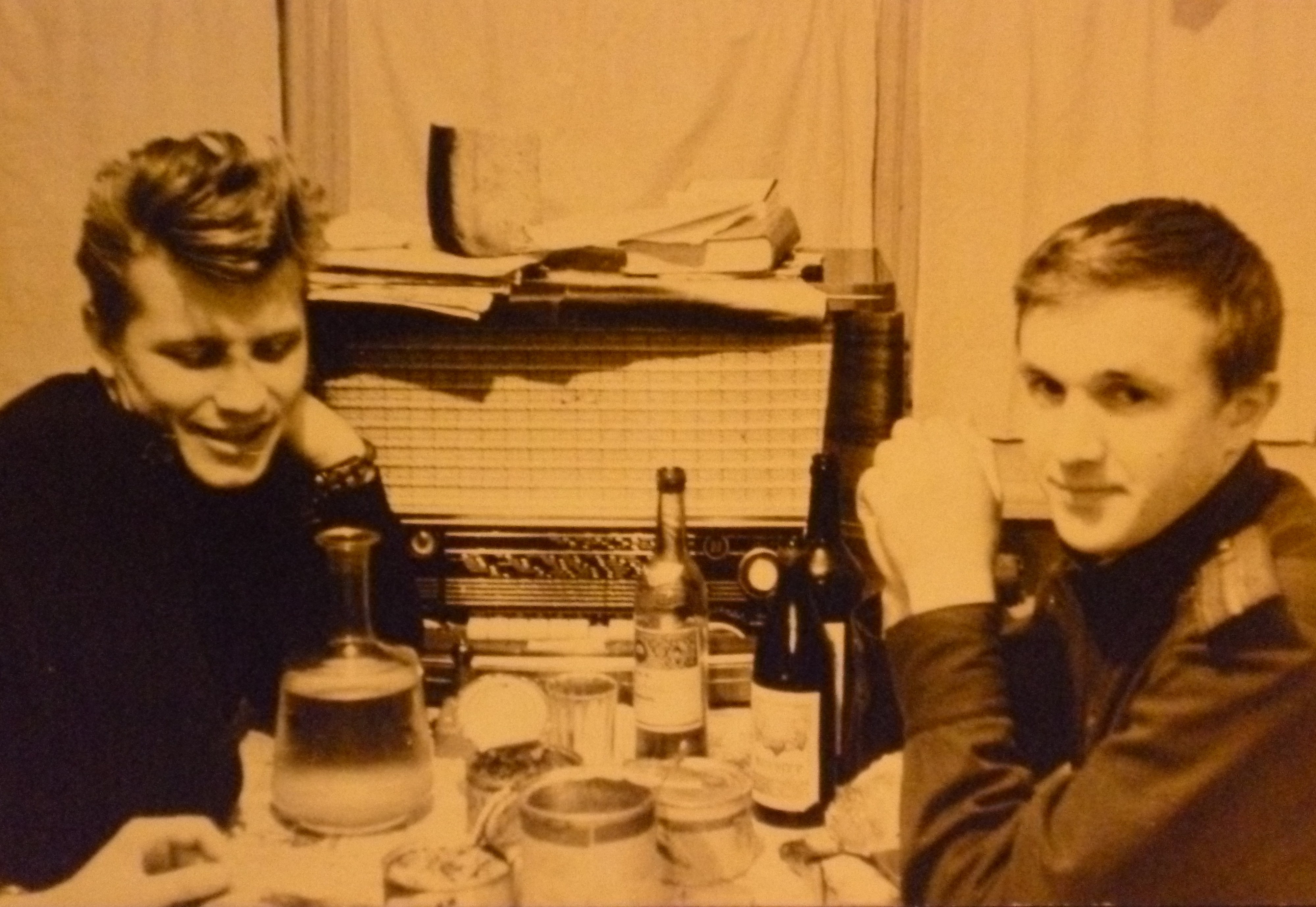
The New Year of 1962 in Dima Tropin’s room (on duty at his own “Festival”). There with Kolya Chernyshov too.
In the autumn of 1961, the training ground championship in 11x11 handball was coming to an end, and our team looked quite formidable. Especially strong in the back line, the defensive six, with Gena Ustimenko as the main “bull” and Zhenya Lebedev, forever complaining about his naturally short fingers. Very unfriendly defenders. And that means the rear was covered.
But if we are to characterize each of the team’s players, then first in importance, without question, was Lev Kostyuk, our goalkeeper, a foundational player. We outfield players, for all our wonderful qualities, were nevertheless a somewhat frivolous bunch, occasionally careless, and Lev always paid for our mistakes on the court.
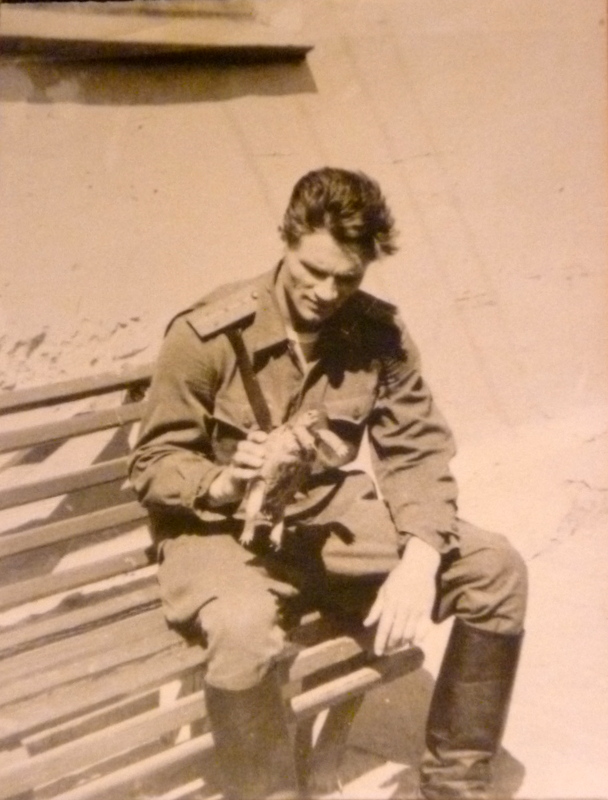
A little turtle lived in my soup plate too. You would open the cupboard at any time, and it would crawl and crawl without rest or stopping in its plate…
What set him apart from all our sporting comrades was his serious attitude toward training and his utmost responsibility in every game, regardless of the opponent’s strength. There was no one else who took knockout blows from the ball not only to the head but also to the most sensitive parts of the body. In truth, he had not joined the team, as they say, straight from the street, but as a first-class athlete from artistic gymnastics. He did not need to learn the splits in goal. And Lev dished it out to everyone during the game and in the post-game reviews—and to me especially. From behind, in the goal, he could see everything. And without such a goalkeeper, our team would never have come into being, that’s for sure. You can sweat and leap around the court as much as you like, but if there’s a hole in the goal…
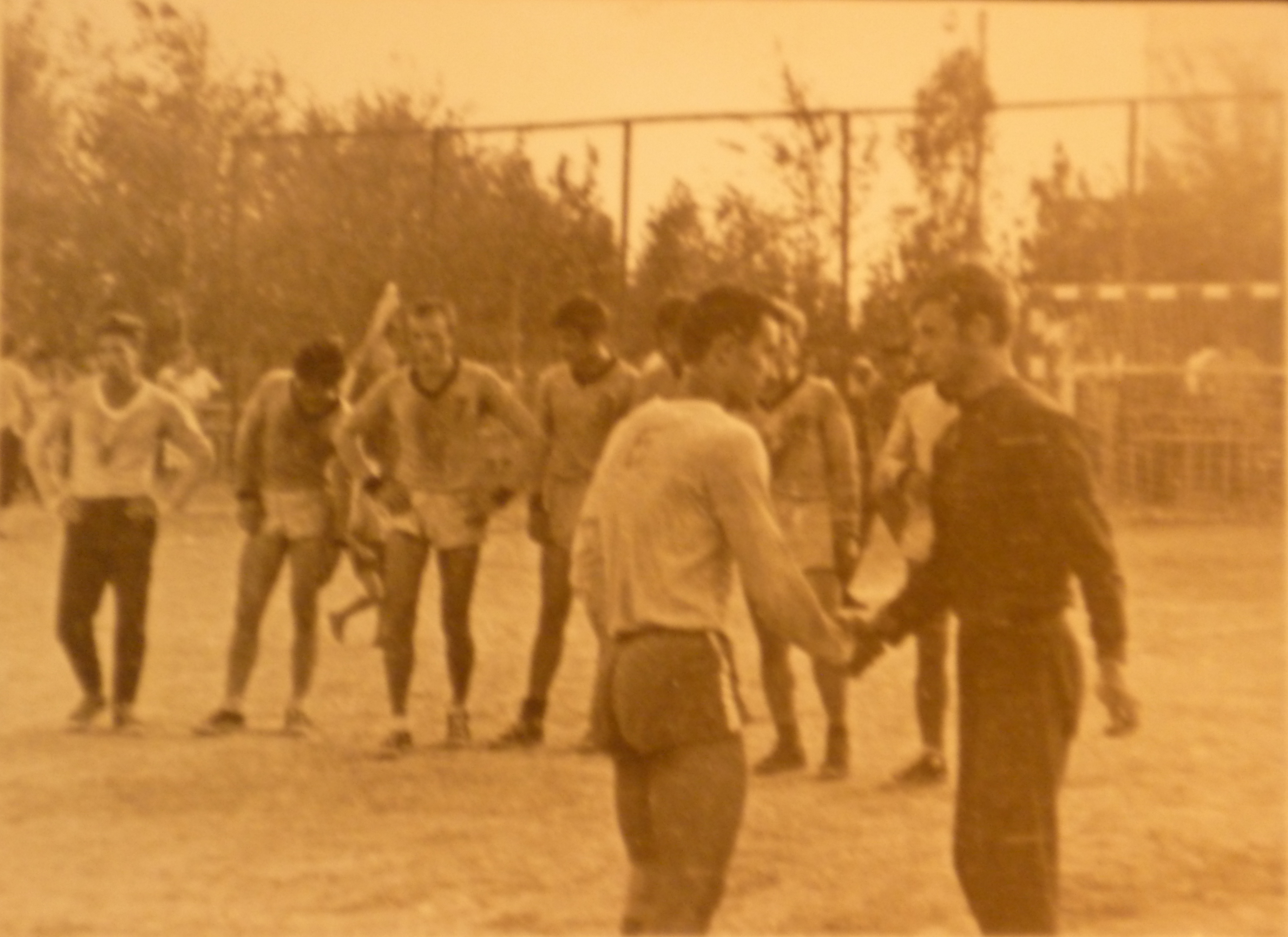
I’m going to thank the referee. Looks like we got beaten. And Lev, with no joy in him, hands on his hips—that means he’ll be swearing. Geshka Pavlov is scratching his leg.
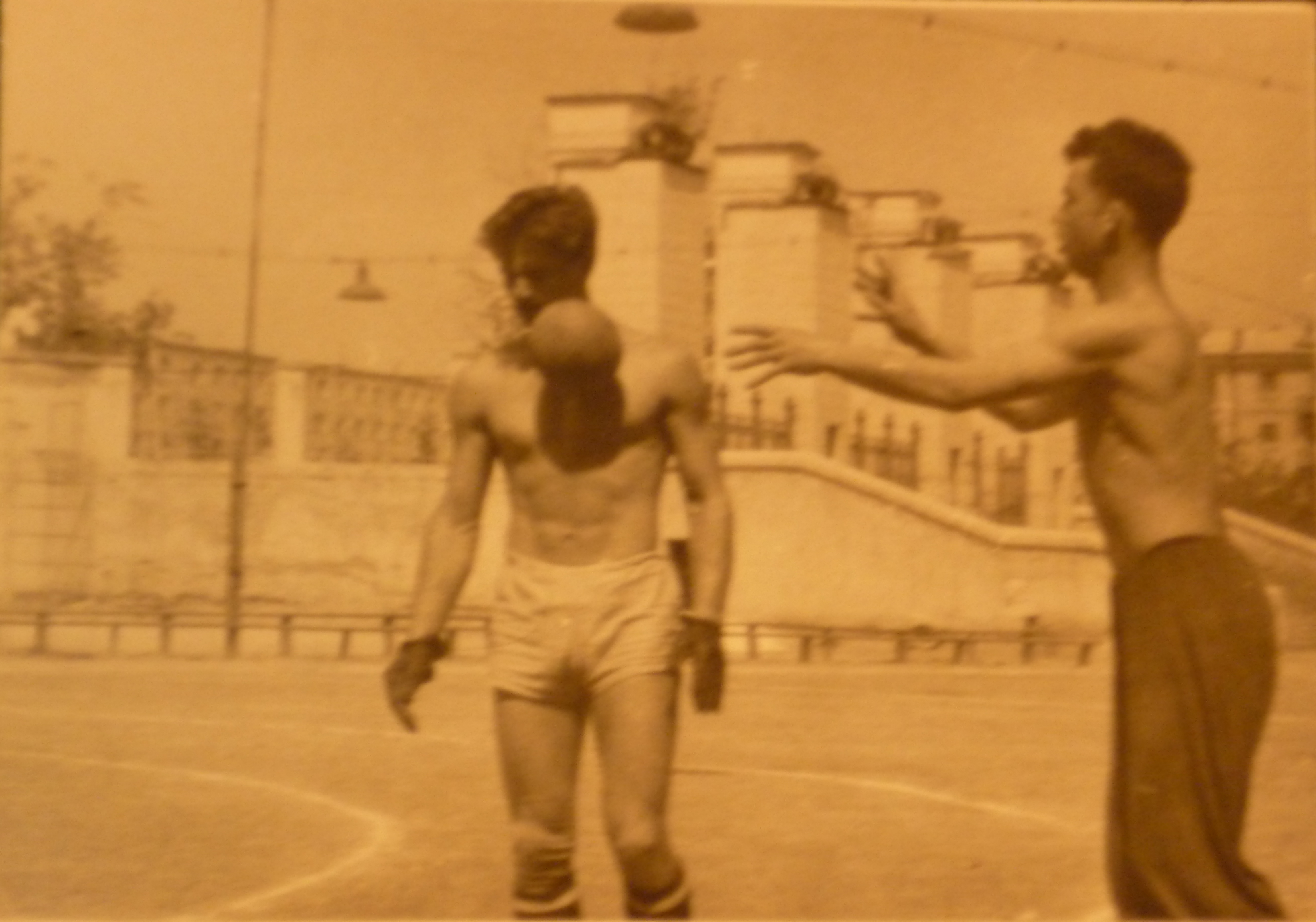
Tashkent. City Cup. Farid is warming Lev up before the game (relatively light throws at his face).
I love everyone I can remember dearly and will not rank them, although I am sorely tempted to devote an entire chapter to such chief sluggers as the incomparable line player “Roughy”—Kolya Chernyshov—and the clever “Fara”—Farid Mukhammedov.
In his younger years, at the school, Roughy took up wrestling. Hence he stood out for his pumped-up musculature and his distinctive wrestler’s warm-up before every game. Without a doubt, such excellent physical conditioning and persistent training made him a leading player—a true line player. Our principal slugger. But I never envied the line players during a game.
To climb into the thick of the opponents, who are eager to “take offense” at the insolent fellow with all their heart; to shove them aside skillfully, within the rules; to take plenty of hits to the face and ribs; to set endless necessary and pointless screens; and, without receiving the ball in a favorable position when the attack breaks down, to race headlong back into defense. That is a line player’s daily life.
But when the ball ended up in Kolya’s hands, the spectator froze in anticipation of a classic, almost circus-like act. A turn on the pivot foot, a powerful push using his pumped-up thighs, a flight toward the doomed goalkeeper, and the ball in the net! The attack was crowned by a spectacular somersault-roll. A favorite of the crowd. The fans, especially the women, roared with delight after Kolya’s tumbles. And how he returned to his own goal with a completely distinctive winner’s strut, tossing his powerful thigh high into the air!
Farid was of an entirely different disposition and played by an entirely different technique. He was a technician and a tactician. He would never charge straight ahead. He respected only combination play, with delicate passes, feints, and dummy attacks. Lacking a powerful shot, he relied on accuracy. I was often scolded by Fara for my senseless frontal attacks, frequently fruitless ones. That was when I plunged into the melee and failed to pass him the ball, though he was completely free. Even now I can see and hear his Kudus-style reproachful cry: “Rooster!” Ah, if only I could turn back time, I would have passed him every ball!
Vova Ambrasovich was a delicate, intelligent fellow. But when the game required it—and I always demanded tough defense—Vol, visibly overcoming himself, even changing in the face and making it thoughtful and detached, would begin “serving up the clients,” with apologies, fortunately possessing an athletic torso and powerful legs for the purpose. If only we had filmed that on movie film so we could watch it again now!
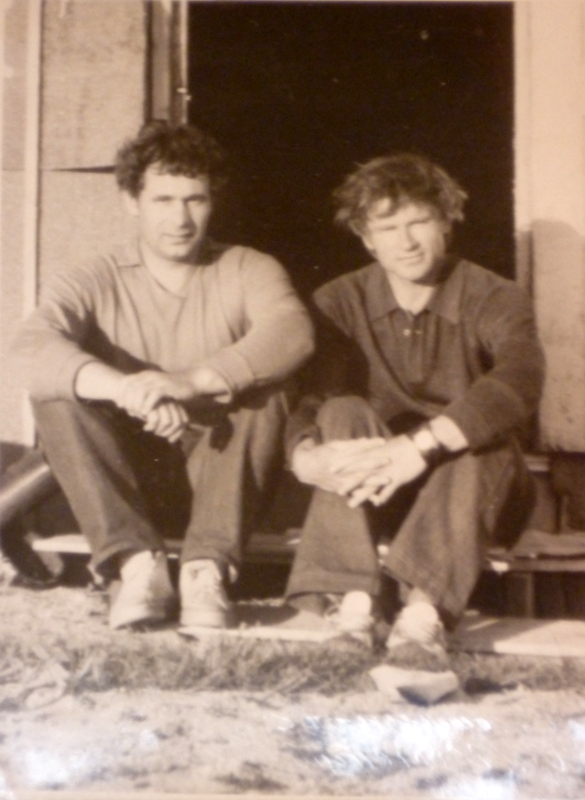
Vol and Lev, conquerors of Sakhalin Island. Seemingly sober in the morning…
Each and every one of those named below contributed to the team’s victories: Yura Sivitsky, Vova Chernushenko, Dima Tropin, Gena Pavlov, Zhenya Lebedev, Gena Ustimenko, Albert Kavriga, Valera Belov, Yura Gruzdev, Tolya Korniyenko, and the rank-and-file Kolya Shuvayev and Tolya Karmishin.
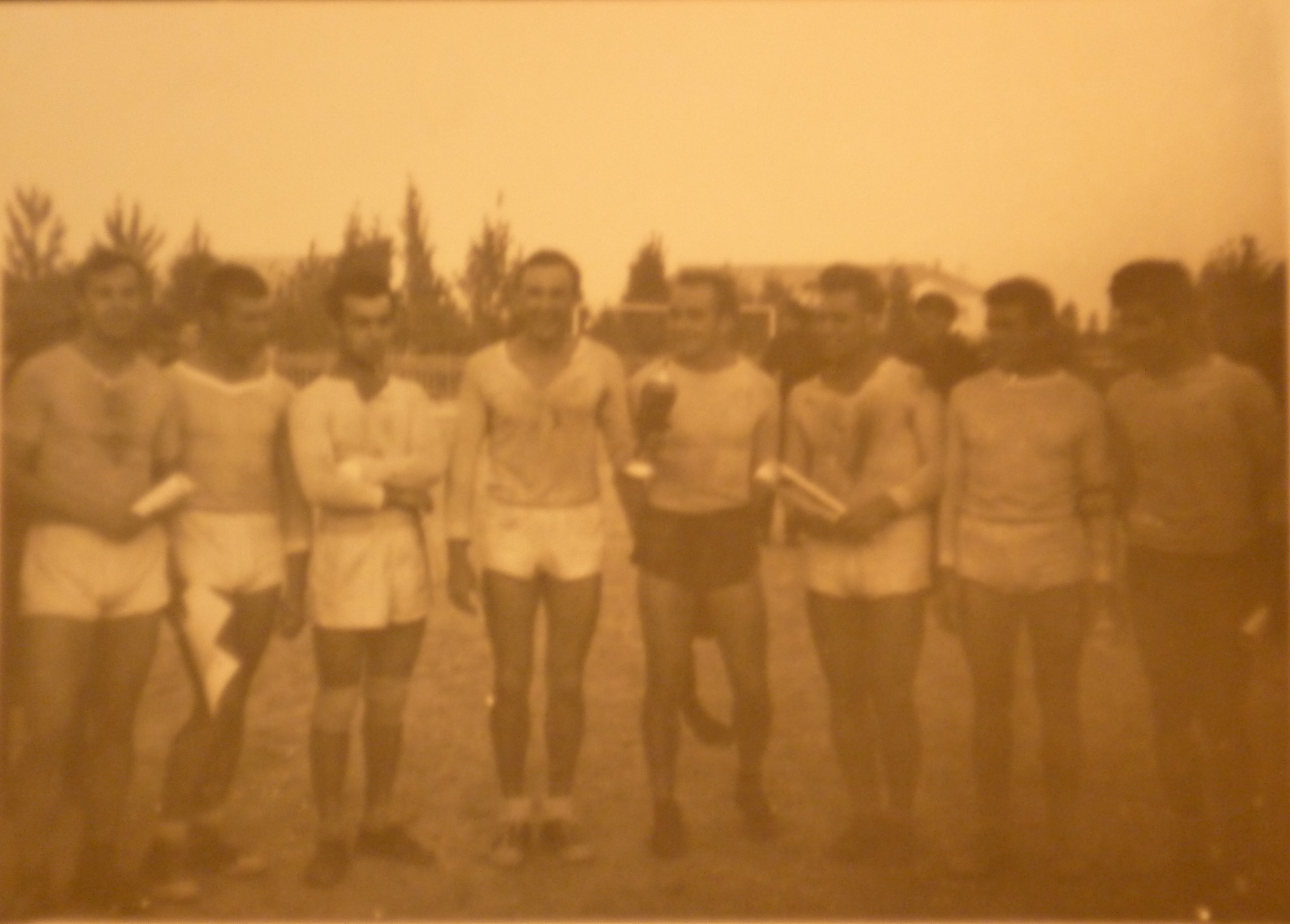
Champions!! From left to right—Zhenya Lebedev, Tolya Karmishin, Farid Mukhammedov, the Happiest Man, Yura Sivitsky, Kolya Chernyshov, Kolya Shuvayev, Vova Chernushenko. Lev did not make it into this shot. A team without a goalkeeper! He is taking the photograph.
The lack of a proper shower in the dormitory was somewhat trying. There was a room for one, but hot water had not been provided. They considered it showy nonsense. Besides, there was no hot water anywhere at all, only in the heating system. So people used it for washing. And since it was exceptionally rusty, simply brown, a sack stuffed with old shirts, underpants with sleeves—long johns—torn sheets, and other rags serving as a filter was fitted over the rubber outlet from the radiator, which was fixed to the ceiling. The water was turned on, and, with your legs half-bent, more or less squatting, you positioned yourself beneath this sack, which quickly began to look more and more like an elongating heavy bag, and washed without delay, since after about half an hour this bag would come off with a wet squelch and fall onto someone’s head or onto the floor—it had finally become clogged with rust at the top. By then the water had also become far from transparent. The filling was taken apart, renewed, and on we went, frozen guards, continuing the process. Two people could not lift the bag and hoist it onto the ceiling hook: it was heavy, slippery, and already horribly cold, the viper. Four was better. Three or four half-washed men would huff and struggle, tying the rusty bag back into place. It was especially bad if the sack of junk was too large. It fell more often, and lifting it to the ceiling and securing it there was very difficult. And you had to wash beneath it bent over more than halfway. At “Ten,” of course, conditions in the dormitory were practically ideal. Wash as much as you like and do your laundry at the same time. Laundry was done exclusively with your feet. Soap the garment and dance on it, jumping up and down. The longer you do it, the cleaner it will be.
The 1962 season—beginning with the first weekend of May—we started playing 7x7 handball, and everyone underwent retraining with Sasha Zhmakin, an officer from the second site. A wonderful, kind fellow, a graduate of MAI. I spent the night in his room several times; I don’t remember which dormitory of “Ten” it was.
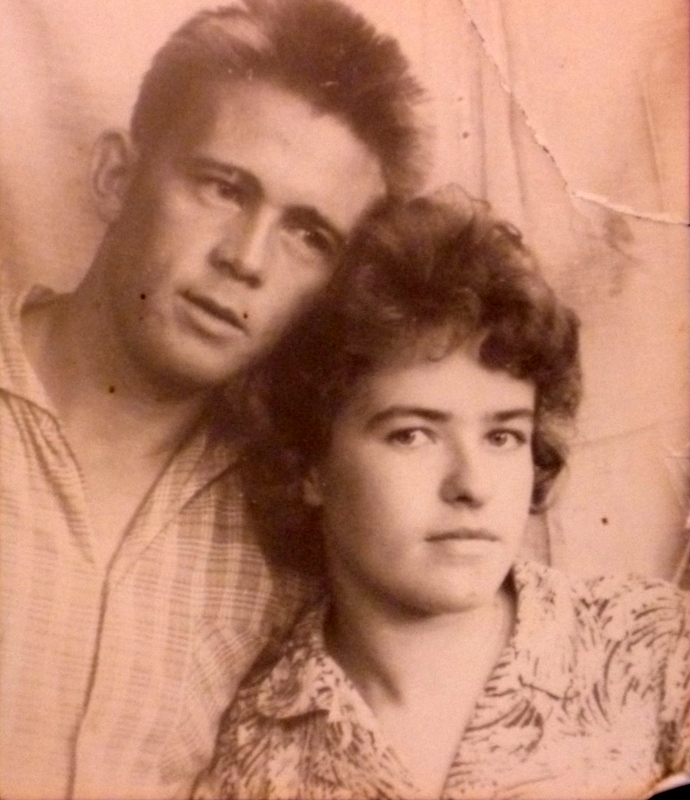
Zoya and Sasha Zhmakin
Before important games, our team would usually gather amicably in the room of Dima Tropin and Slava Akimov. Why precisely in that room? Somehow it was the coziest, and Dimenty’s personality itself was inviting. He was a cadet, that is, he had graduated from the Novocherkassk Suvorov Military School before entering the one in Kharkiv. An excellent radio amateur, a competent engineer, and a phlegmatic man in everyday life. His natural state and position was half-reclining on the bed, a cigarette or a book in his hand, and performing an original, silent spit, as if flicking off a crumb of tobacco that had stuck to his lips. But without tobacco—just like that. He was too lazy even to go to the toilet. The harsh truth was that the communal toilet stood far from the dormitory, a good two hundred and fifty to three hundred meters to the north. A serious structure without doors, with no fewer than thirty holes. It was always generously dusted with chlorine, white on white. They spared none. In winter, in frost and strong wind, trudging there was of course not much fun. Every evening someone would shout down the corridor in a hoarse voice: “Who’s going North?” Those in need would gather, and in a cheerful company head out into the night, to the latrine. Once Demyan set a record: he did not visit the latrine for about five days. We practically had to lead him to the privy under the arms. He had lain there too long.
So, let us mentally return to Dima’s room in the story. Preparations for the upcoming game, or the review of the one just played, ended with drinking coffee. We drank what the dear Voentorg delivered. And that was “Ground black coffee,” such-and-such a grade, such-and-such a price. There were no other explanations of what had been poured into the packet. Instant coffee did not exist then. We drank tea less often, and it was of appalling quality anyway—Georgian only. A week before the final games, I imposed a dry law; everyone took it seriously and followed it, which was not at all easy. The thing was that high-quality technical alcohol on the site, in the officers’ rooms, particularly those of the refuellers, was, as they say, available by the flood. For flushing their own pipelines alone, they received 400 kg after every launch. Alcohol stood in some rooms on the table in a decanter or in a canister in the cupboard. And it was not considered anything particularly valuable.
Then, about three years later, the alcohol allowance for servicing the equipment was cut tenfold, and supplies of “khmyz” began to run short. At every drinking party, it alone, the dear old stuff, was served as the merriment-maker. For some, it became a bad habit to “khmyz” before and after dinner. And we were fed free of charge according to the flight ration, as officers of a unit on combat duty. In those days, the 8K74 (R7) rocket was the only rocket with a range sufficient to deliver a nuclear warhead to the USA.
The beginning of a twenty-four-hour combat duty shift consisted of a ceremonial parade before dinner—roughly two dozen officers in formation, the next duty shift. Someone from headquarters would read out the order, ending with the phrase: “…to defend the borders of the USSR, report for combat duty!” The entire shift would immediately go to dinner, and afterward everyone went wherever they pleased, while the younger men headed for the sports grounds. But if an alarm was sounded, we were the first to hurry to the MIC and prepare whatever was needed before the rest of the regiment’s officers arrived. The regiment had more than three hundred officers, and to gather them quickly during an alarm—alarms usually happened at night—a so-called “alarm group” was organized from each unit. This consisted of up to twenty nimble soldiers permanently stationed in one of the dry basements of a residential building at “the ten,” converted for housing. Bunks had simply been set up in the basement. When an alarm was announced, these nimble fellows would fly into the town and each follow his own route—pounding on doors and rousing the people. Every officer had an “alarm suitcase” ready. It was a medium-sized suitcase, quite suitable for going on leave; it contained a change of underwear and everything needed for everyday life, even at least two tins of canned food. The contents of the suitcases were regularly inspected by the authorities. Crowds of “concerned vacationers” ran to the assembly point, from which they were transported by road to sites 31 and 33. The necessary horizontal tests of the rocket were carried out; the “bigheads” who had arrived docked the “head,” and the rocket was taken to the launch position, placed in the launch structure, and everyone waited to see what would happen next. Would it be fueled with components or not? Once our rocket was fueled, it had to be launched. Otherwise, if the components were drained, the rocket had to be dismantled and sent to Kuybyshev, to Progress, for washing.
And it all ended with the command, “all clear.” The rocket was not fueled with propellants; it was placed on the erector, and the locomotive hauled it back to the MIC. The “bigheads” took away the payload fairing and disappeared to their site 38. The sleep-deprived men, grumbling softly, scattered to their workplaces to catch a chance to doze off, since each such “game of war” lasted up to two days! And every crew had its own workplace. For some it was a control room, for others a laboratory, and for others an immense hall.
And then there were the “evacuations,” which plagued us even more than the alarms. The thing was that several kilometers from our site stood site 43, where a year earlier a serious accident had occurred at its launch position (site 41). During pre-launch vertical tests, with the launch personnel and attached personnel gathered in full, an 8K64 rocket (R16, mass 140 tons) exploded, carrying more than a hundred testers, along with the first Commander-in-Chief, Marshal Nedelin, to the next world.4
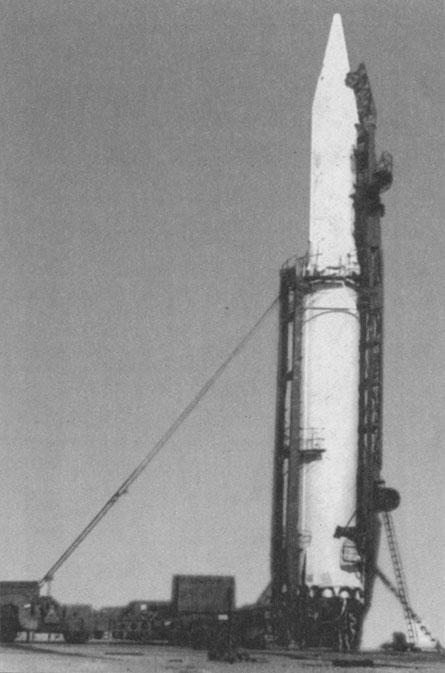
24 October 1960, 8K64. Before the explosion.
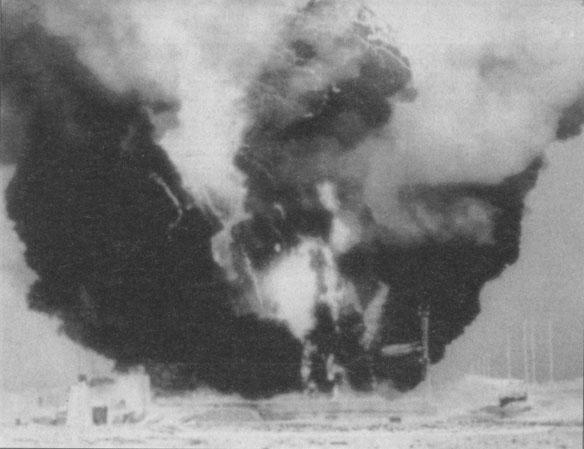
The explosion.
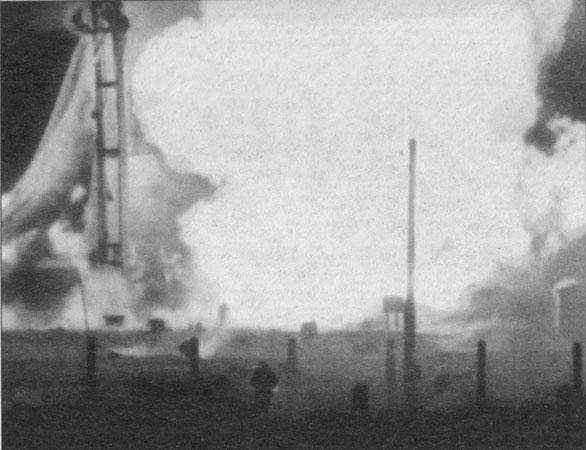
Burning human torches. They run… fall… crawl on all fours. They freeze into smoking mounds.
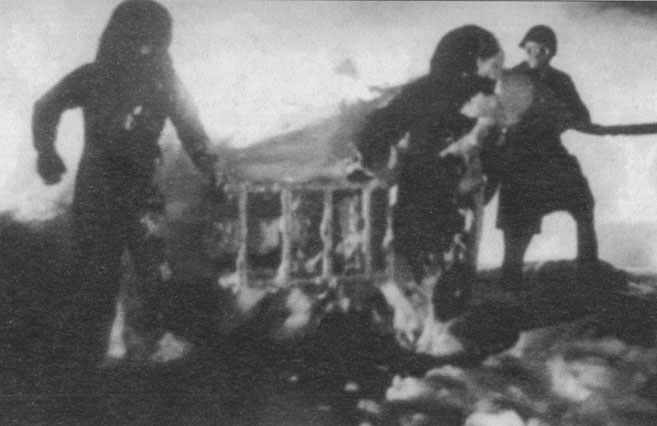
The emergency rescue team is at work. There was not enough protective equipment for all the rescuers. In the deadly poisonous environment of the fire, some worked without gas masks, in ordinary greatcoats.
The rocket was Dnipropetrovsk-made, shoddy in quality and, on top of that, powered by poisonous fuel components. So whenever our neighbors hauled their stinking contraption out to the launch site, our entire unit was evacuated to the steppe. And since work on this wretched rocket went on permanently, it plagued us day and night. Autumn nights in Kazakhstan are very cold. Everything living at site 32 had to be evacuated—and that meant not only our unit, but also the builders, attached personnel, civilians, and the training center: more than a thousand people. All this crowd found whatever arrangements it could in the night. Here and there one could see little campfires, cigarette embers; someone tried to doze. And by November the nights were already cold. That was when I regretted having sent the parcel with my greatcoats to Krasnoyarsk. I froze in my little cape. But all our attention was on the neighbors. They were no more than five km away.
I saw enough of their explosions and emergency launches! And how many times we all ran, a thousand-strong crowd, from the orange and russet clouds of heptyl and nitric acid, like a herd of sheep! The trouble was that the standard-issue combined-arms gas mask did not filter these components. You needed an isolating one, like the IP-46. Still, I had my fill of those magnificent Tyuratam stars. Slavs are a special people; some of the “cleverest” managed to sleep through an evacuation in the dormitory or play a round of cards. The fight against evaders was waged fiercely by patrols, with threats to break down doors—but what a prize! Everyone else froze stiff in the steppe, sometimes until morning, while you slept like a king in your little bed!
I welcomed the New Year of 1962 in the dormitory of group 2, in Dima Tropin’s room—“Tropinin’s.” Kolya Chernyshov, Yura Gubarev, Tolya Batukov, Vasya Drevyatnikov, Dima, and I were there. We polished off a flask of spirits, gave it a “burn-off”5, sang Bulat Okudzhava’s songs and the obligatory “The space charts are tucked into the map cases…” ending with the major-key assertion, “on the dusty trails of distant planets our footprints will remain!” Hungarian lecho was considered the best snack to go with the spirits. And if Dimka also boiled some pasta to go with it… Delicious! The standard snack assortment included small fish or sprats, tomatoes in their own juice, eggplant caviar, and black and white bread. Dinner in our flight canteen was laid out for all the officers, but most of them went home, to “the ten,” so anyone starting an evening-and-night gathering would carry whatever was tastiest from the canteen to the dormitory, plates included6.
But when a large company gathered, the main song-starters were Vitaly Morozov and Gena Ustimenko. “Why did you punish Vanka—Morozov,” “Do you hear the boots pounding,” “The Last Trolleybus,” “A crisp crust is wafting in from the windows…” Where are those years, and where are those boys??
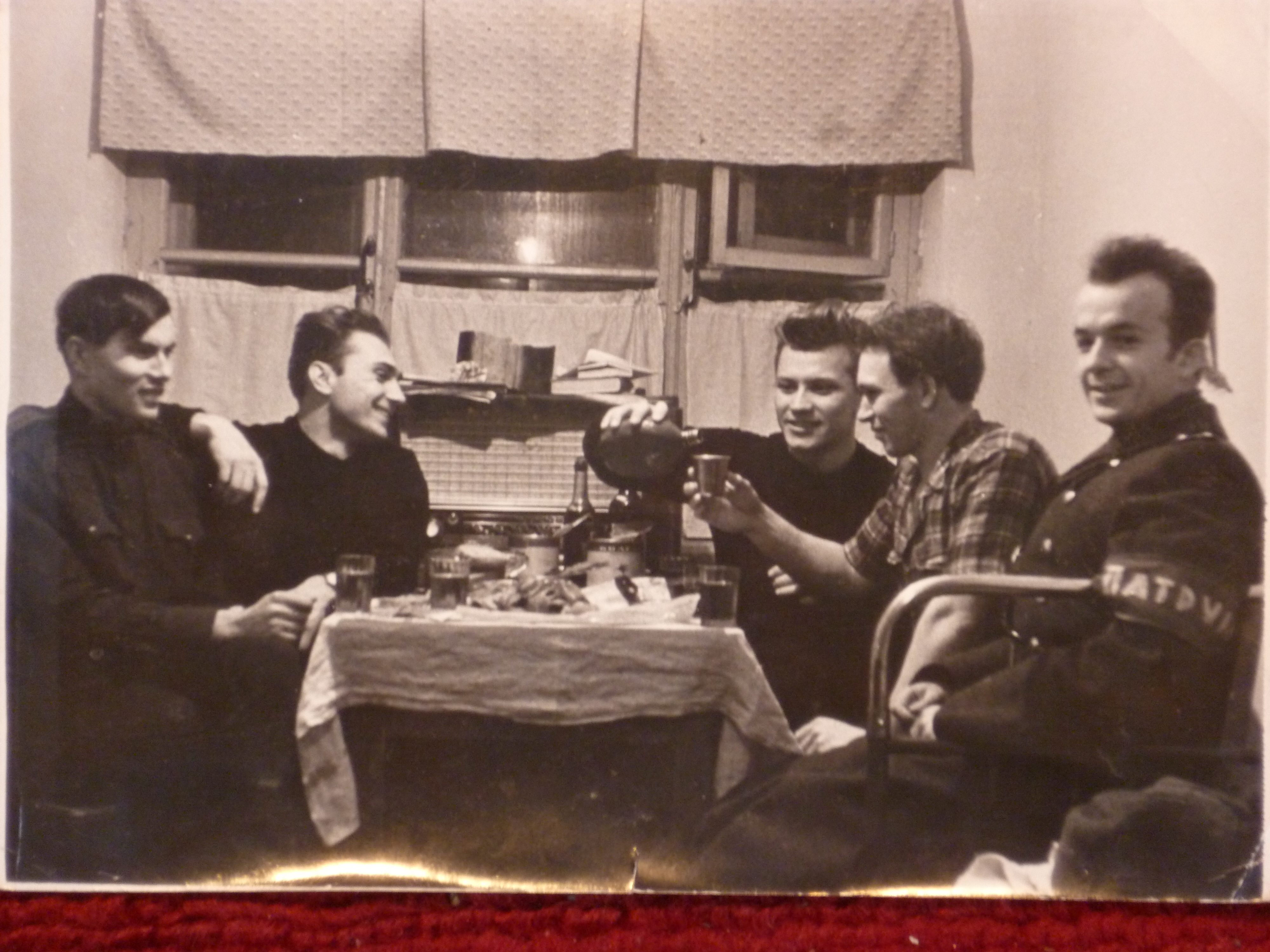
Drevyatnikov, Batukov, Chernyshov, Gubarev, Tropin.
Demian had a miracle radio set called “Festival” standing on his table. In those days it was the best apparatus in the world, a gold medalist at the World Exhibition in Brussels. They knew how to make household appliances in the USSR too, now and then.
Dima built an adapter-converter for the 13-, 16-, and 19-meter bands into a red SHRO plug cover7, and we listened to enemy voices without the “jammers.” At the same time, on the BBC, the hosts of the Russian-language program, Johnny and Mary, introduced the world to the fledgling “Beatles,” and regular broadcasts by Victor Sylvester’s orchestra were aired.
Footnotes
-
The “Seven” 8K74
↩ -
The rocket carried a monoblock thermonuclear warhead with a yield of 3 Mt. It was attached to the central block with three pyrolocks. The warhead’s characteristics allowed it to strike a large-area target by means of either an airburst or a ground nuclear explosion. The warhead of the rocket, which was to enter the dense layers of the atmosphere at a speed of 7900 m/s, was a cone with a half-angle of 11 degrees, a length of seven meters and 2 decimeters, and a mass of 5500 kg. Later, a lighter and smaller warhead was developed for R-7A rockets.
↩ -
One of the units of the Plesetsk test range (military unit 14056), with two launch sites.
↩ -
According to the testimony of B. E. Chertok, S. P. Korolev’s deputy: “84 soldiers and officers were buried in a mass grave in the city park. (Only three years later was an obelisk with the names of those buried there erected over it.) Forty-two zinc coffins were flown away to cities where the dead had lived or worked.” B. E. Chertok. Rockets and People. The Hot Days of the Cold War. M. Mashinostroyeniye, 1997.
↩ -
The emptied flask is laid on its side, and a match is carefully brought to its neck. A micro-simulation of the “Burn-off” operation of the medium-range R5 missile (8K51, fuel—92 percent ethyl alcohol, oxidizer—liquid oxygen).
↩ -
The canteen manager regularly collected these plates from the dormitories. Amid scandals.
↩ -
Plug Connector Detachable. A huge, roughly two-kilogram, square connector with about a hundred pins. A powerful electromagnet built into it tore it away from each block of the cluster at launch.
↩